

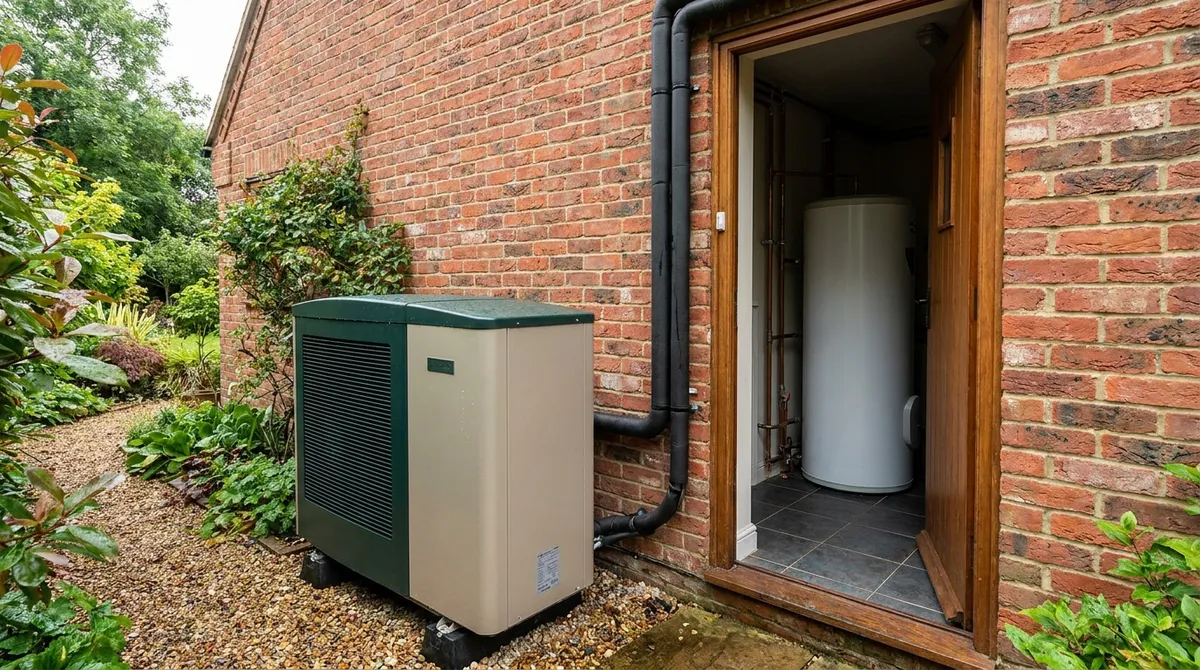
You often hear that a heat pump “produces” heat. That’s inaccurate, and this nuance explains its whole efficiency: a heat pump doesn’t create heat, it moves it. It goes and fetches calories already present in the air, the ground or water — free and inexhaustible — and concentrates them to heat your home. This guide explains that principle simply, without jargon, so you understand why this is the most economical way to heat today.
The principle: move the heat, don’t make it
Picture a fridge. It captures the heat inside the compartment and releases it at the back, into your kitchen — that’s why the grille behind the appliance is warm. A heat pump does exactly the same thing, but in reverse and on the scale of a house: it captures the heat outside and releases it inside.
Even when it’s cold, the outside air contains thermal energy. As long as you don’t reach absolute zero (–273 °C), there are still calories to capture. The heat pump knows how to extract them at 5 °C, at 0 °C, and even in below-freezing temperatures — then bring them up to a useful temperature to heat your rooms or your water.
It’s this fundamental difference — moving rather than producing — that lets a heat pump do better than a conventional electric radiator, which dumbly turns each kWh of electricity into a single kWh of heat.
The four steps of the cycle, in brief
To carry heat from a cold point to a warm point, the heat pump circulates a refrigerant in a closed circuit. This fluid has a precious property: it changes state (liquid ↔ gas) at low temperatures. The cycle boils down to four stages.
1. Evaporation
The fluid, very cold, circulates in a heat exchanger exposed to the outside source (air, ground or water). Since it is colder than this source, it absorbs its calories and turns into a gas. The free heat from outside enters the circuit.
2. Compression
The gas passes into the compressor, the heart of the machine. By compressing it, the compressor raises its temperature sharply: the fluid becomes a scorching gas. This is the only step that consumes electricity — and it’s precisely here that the efficiency of the whole system is decided.
3. Condensation
The hot gas gives up its heat to your heating circuit (blown air, radiator water or underfloor heating) through a second heat exchanger. As it cools, the fluid becomes liquid again. The heat is delivered into the home.
4. Expansion
The liquid fluid, still under pressure, passes through an expansion valve that drops its pressure and temperature. Now it is very cold again, ready to start the cycle over. The loop is closed — and it runs continuously for as long as you need heat.
In a few questions about your home and your needs, get a first estimate of the suitable type of heat pump and the savings you can expect.
Launch the simulator →This summary is enough to grasp the essentials. If you want to dig into the detail of thermodynamics — pressures, temperatures, choice of fluid — we develop it in a dedicated guide: the cycle in detail.
Why 1 kWh of electricity gives 3 to 4 kWh of heat
This is the point that always surprises, and it’s the whole appeal of the system. The compressor consumes electricity, but the heat delivered does not come from that electricity: it comes mostly from the free calories captured outside. The electricity only serves to run the cycle, like a pump moving water without creating it.
Result: for every 1 kWh of electricity consumed, a heat pump generally delivers 3 to 4 kWh of heat. This ratio has a name — the COP, or coefficient of performance.
For every 1 kWh of electricity consumed, a heat pump delivers 3 to 4 kWh of heat. The rest comes from the free calories in the environment — that’s what makes this heating so economical.
The higher the COP, the more efficient the machine and the less your bill climbs. This figure isn’t fixed: it depends on the temperature gap between the captured source and the heating circuit, hence on the season, the type of pump and the quality of your installation. We detail its measurement and its variations in a separate guide: the COP.
Three families of heat pumps
All heat pumps rely on the same cycle, but they differ by the source from which they draw the calories and by the way they distribute the heat. Three families cover most residential installations.
The air-to-air heat pump
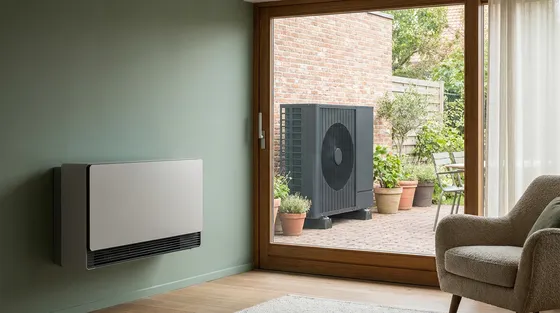
It captures the calories from the outside air and delivers them as warm air blown into the rooms, via one or more indoor units (the “split” principle). Simple to install, often reversible to cool in summer, it does not however produce domestic hot water.
The air-to-water heat pump
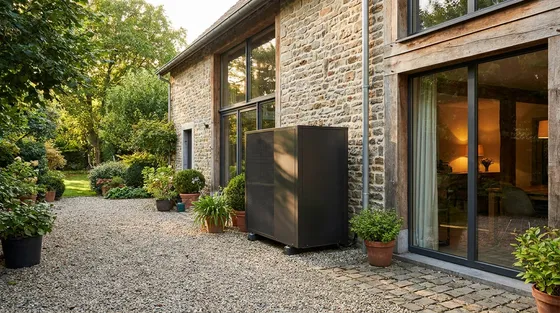
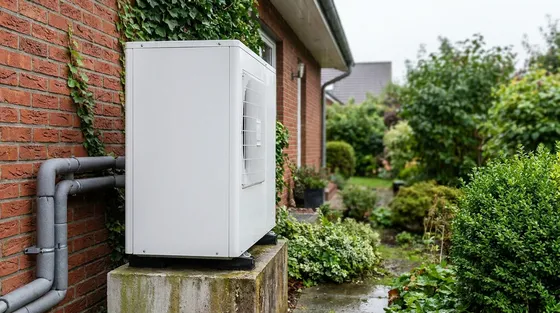
It also draws from the outside air, but transfers the heat to a water circuit: radiators, and above all underfloor heating. It can cover both heating and domestic hot water, which makes it the most common solution in renovation as well as in new builds.
Geothermal (ground-to-water)
It draws the heat from the ground, via buried collectors. Since the underground temperature is stable all year round, its performance is the most regular and the highest, even in the depths of winter. In return, the installation is heavier and its budget larger.
Choosing between these systems depends on your home, your existing heating and your hot water needs. That is precisely the subject of our comparison: air-to-air or air-to-water, which to choose?.
What makes it an efficient way to heat
Oil or gas heating burns a fuel: each kWh of heat requires at least one kWh of paid-for energy, and some of it goes up in smoke. The heat pump, on the other hand, multiplies: a small amount of electricity mobilises a large amount of free heat. That is the fundamental reason for its efficiency.
Three factors further boost this performance day to day:
- Good insulation. The less heat the house needs, the lower the temperature the pump works at, hence the higher its performance.
- Low-temperature distribution. Underfloor heating or oversized radiators, fed at around 35 °C, allow a far better COP than scorching radiators.
- Correct sizing. A pump properly calibrated for your home avoids overconsumption and the short cycles that wear out the equipment.
Well designed, an installation combines free heat from the environment and electricity — ideally from your own solar panels — for heating that is both comfortable and frugal. To discover all the solutions, their prices and the grants, head to our heat pump hub.
The 30-second recap
- A heat pump moves heat, it doesn’t make it: it captures the free calories in the air or the ground.
- A refrigerant and a compressor run a four-step cycle to bring this heat into the home.
- For every 1 kWh of electricity, it delivers 3 to 4 kWh of heat: that’s the COP.
- Three families — air-to-air, air-to-water and geothermal — depending on the captured source and the distribution method.
- Well insulated and well sized, it’s the most economical heating today.
Guide verified in May 2026 · updated every year