

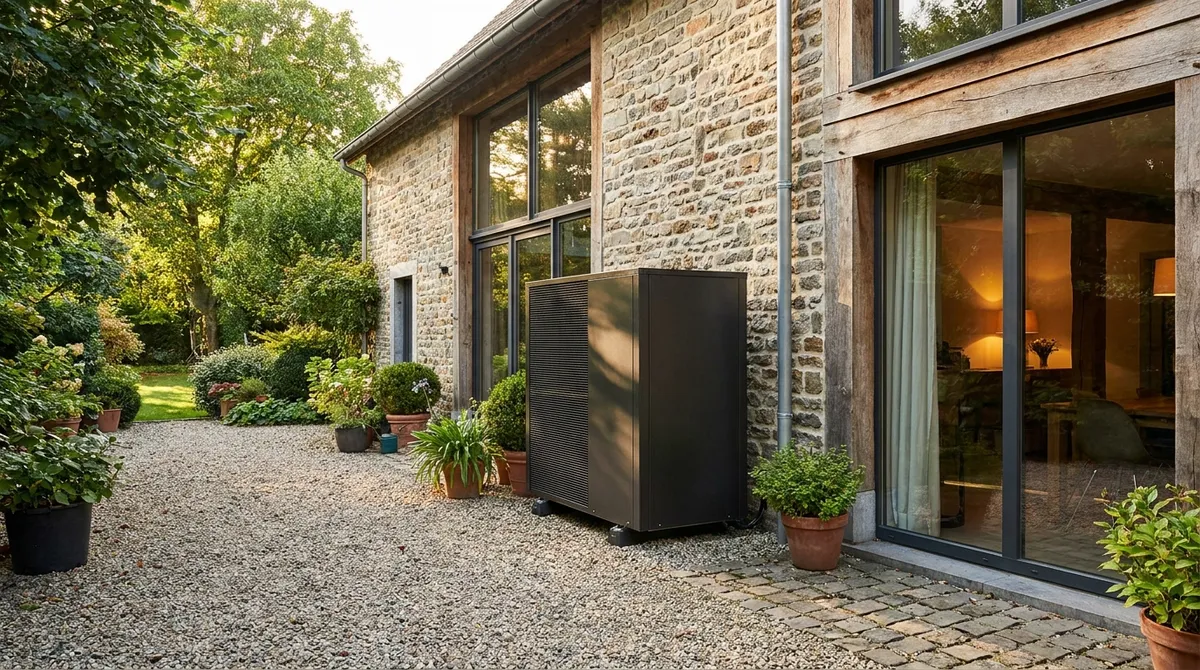
Replacing your heating with a heat pump is a sizeable investment — around €11,000 installed for an air-to-water unit. Before signing, one legitimate question always comes back: does this investment really pay for itself? The answer is almost always yes in Belgium, but it deserves some nuance. Everything depends on the heating you are replacing, on your home’s insulation and on your heat emitters. Here is an honest analysis, backed by real figures.
Why a heat pump lowers the bill
The principle of a heat pump is not to produce heat, but to move it: it draws the free calories from the outside air (or the ground) and releases them indoors. That is what explains its extraordinary efficiency.
This efficiency is measured by the COP (coefficient of performance). A COP of 3.5 means that for every 1 kWh of electricity consumed, the pump delivers 3.5 kWh of heat. In other words, your heating consumption is divided by three to four compared with an electric convector, which turns 1 kWh of electricity into 1 kWh of heat, no more, no less.
This is the factor by which a heat pump (COP 3.5+) divides your heating consumption compared with direct electric heating. That is the whole secret of its profitability.
It is this efficiency that changes everything. Even with electricity at around €0.35/kWh in Belgium — more expensive than gas or oil per kWh — the cost of the heat produced by a heat pump remains competitive, because far less of it is needed.
The real saving depending on your current heating
Profitability is not judged in the absolute: it depends on what you are replacing. The more expensive and inefficient your current heating, the more the heat pump makes a difference.
Replacing oil: the clearest gap
This is the most favourable case. An old oil boiler often shows a poor real efficiency, with a fuel whose price remains volatile and subject to carbon taxation. Switching to a heat pump generally means several hundred euros saved every year on heating an average home. It is in this scenario that the payback period is shortest.
Versus gas: a more measured gain
Natural gas, long the cheapest heating per kWh, remains a serious competitor. The saving exists, but it is more moderate and more sensitive to changes in energy prices. The heat pump nevertheless keeps two advantages: it frees you from a fossil fuel with an uncertain price, and it adds value to your property (better EPC).
Against direct electric heating: comfort that’s finally affordable
If you heat with electric convectors, the calculation is clear-cut: for equal comfort, the heat pump consumes three to four times less electricity. The annual gain is significant and the comfort is in a different league from “toaster” radiators.
The investment and the support that reduces it
An air-to-water heat pump costs around €11,000 installed for a single-family home, before support. It is this gross amount that frightens people — but the net amount is quite different once public support is deducted.
- 6% VAT instead of 21% for homes more than ten years old: an immediate, automatic saving on the bill.
- Regional grant: up to €4,000 in Wallonia depending on your income and the type of installation, up to €4,500 in Brussels.
Combined, this support can take back a substantial share of the investment. That is what turns an €11,000 budget into a far more digestible net figure, and it is the main lever of profitability.
Amounts by income bracket, technical conditions and steps to take: the full details of the heat pump grant in Wallonia, updated for 2026.
See the Wallonia grant →The payback period: how many years?
This is the real question. The payback period is the number of years needed for the annual savings to repay the net investment (grants deducted).
When replacing an oil boiler, in a properly insulated home, this payback period is often a matter of a few years. Against gas, it logically lengthens, because the annual saving is smaller. But once that break-even point is passed, every year that goes by is a year of net gain.
This is where the heat pump reveals its value over time. Over a lifespan of around fifteen to twenty years, the cumulative gain runs into the thousands of euros, even in a cautious scenario. The unit does not merely pay for itself: it pays off over the long term.
Every home is a special case. Our simulator estimates your annual savings, your grant and your payback period based on your real situation.
Launch the simulator →The conditions for it to be truly worth it
Everything above assumes a well-thought-out installation. A poorly sized heat pump, or one fitted in an unsuitable home, can disappoint. Two conditions are decisive.
Proper insulation
A heat pump delivers heat at a moderate temperature. In a leaky home, a huge amount of heat has to be produced, the real COP drops and the saving evaporates. The better insulated the home, the more profitable the heat pump. Before drawing up a quote, it is therefore worth looking at the state of the insulation — the roof first of all.
Low-temperature emitters
A heat pump performs at its best when the heating water circulates at a low temperature: underfloor heating, or generously sized radiators. With small old radiators that demand very hot water, efficiency falls. This point is checked during the on-site survey and directly determines your savings.
Beyond the financial calculation
Profitability is not just about the payback period. A heat pump adds value to your property by improving its EPC, frees you from fossil fuels and their uncertain prices, and can, in its reversible version, cool your home in summer. These are real benefits, even if they don’t fit into a single spreadsheet line.
That said, one has to be honest: the heat pump is not the universal miracle solution. In a very poorly insulated home that is impossible to renovate, fitted exclusively with small high-temperature radiators, the calculation can prove less favourable. That is precisely why a personalised quote is worth more than a national average.
The 30-second recap
- COP 3.5+ — the heat pump divides your heating consumption by three to four.
- ~ €11,000 installed (air-to-water), but the net amount drops with 6% VAT and grants.
- Up to €4,000 in grants in Wallonia, €4,500 in Brussels depending on income.
- Payback period of a few years, above all when replacing oil — then net gain.
- Real profitability = good insulation + low-temperature emitters.
Guide verified in May 2026 · updated every year