

“Store your solar surplus without installing a battery, for a few euros a month.” The argument hits home, especially now that physical batteries weigh heavily on a budget. But behind the promise lies a subscription service with sometimes opaque rules. So, a scam or a genuine good deal? This guide takes the concept apart point by point, without indulgence, so you know whether the virtual battery has a place in your photovoltaic project.
A virtual battery is not a battery
Let’s start by clearing up the misunderstanding: a virtual battery stores nothing in your home. There’s no box on the wall, no cells, no electrons set aside. It’s a contractual service offered by an energy supplier, and the word “battery” is mostly marketing.
The principle is purely an accounting one. When your panels produce more than you consume, that surplus is injected into the public grid. The supplier records it in a virtual meter, in your name. Later — in the evening, or in winter — when you consume more than you produce, you “take back” this already-credited energy, instead of buying it at full price.
The electricity grid therefore plays the role of the battery. You don’t buy equipment, you rent an accounting line in your energy contract.
This is what a virtual battery actually stores in your home. Everything happens on the grid and in a supplier’s spreadsheet: without a grid connection, the service is useless.
How it works in Belgium
In Belgium, the virtual battery arrived in the wake of the gradual end of the meter that ran backwards. With smart meters, injection and withdrawal are measured separately: your surplus no longer automatically cancels out your consumption. It’s precisely this gap that the virtual battery fills — for a fee.
In practice, you subscribe to an offer with a supplier. Each kWh injected feeds your virtual “reserve”; each kWh taken back is deducted from it. As long as your virtual meter is positive, you don’t pay the cost of the energy taken back — but beware, it’s rarely that simple.
The conditions that change everything
- An annual cap. Most offers limit the “storable” volume to your annual consumption. Beyond that, the surplus is bought back at a low rate, like a standard injection.
- A reset to zero. The virtual meter is generally settled once a year. The surplus built up in summer doesn’t carry over indefinitely into the following winters.
- The fees that remain owed. This is the point most often left unsaid: even when “taking back” your energy, certain grid fees and taxes are still billed on the kWh withdrawn.
A virtual battery doesn’t mechanically remove the prosumer tariff or all the distribution fees. Check line by line what remains on your account for the energy taken back — that’s where the real profitability is decided.
Understand the prosumer tariff →Costs and subscriptions: where the shoe pinches
The heart of the criticism comes down to one word: the subscription. The virtual battery is never free. Depending on the offer, you pay:
- a fixed monthly or annual subscription for the virtual storage service;
- sometimes a flat fee per kWh taken back from your reserve;
- possibly a less competitive energy price on the associated contract, which “funds” the service elsewhere.
The classic trap: people compare the subscription price (low in appearance) with the cost of a physical battery (high), and the virtual battery looks unbeatable. But the right calculation is to compare the total annual cost of the service with what you actually save on the energy taken back. On small surpluses, the subscription can simply eat up the gain.
“The virtual battery is neither a scam nor a miracle: it’s a subscription product. The only arbiter is the total annual cost compared with your real gain — not the brochure slogan.
Virtual battery or physical battery?
Both carry the word “battery”, but they don’t play in the same category at all. Putting things side by side avoids many disappointments.
No hardware. Your surplus is credited on the grid and taken back later, against a subscription. Depends entirely on the grid.
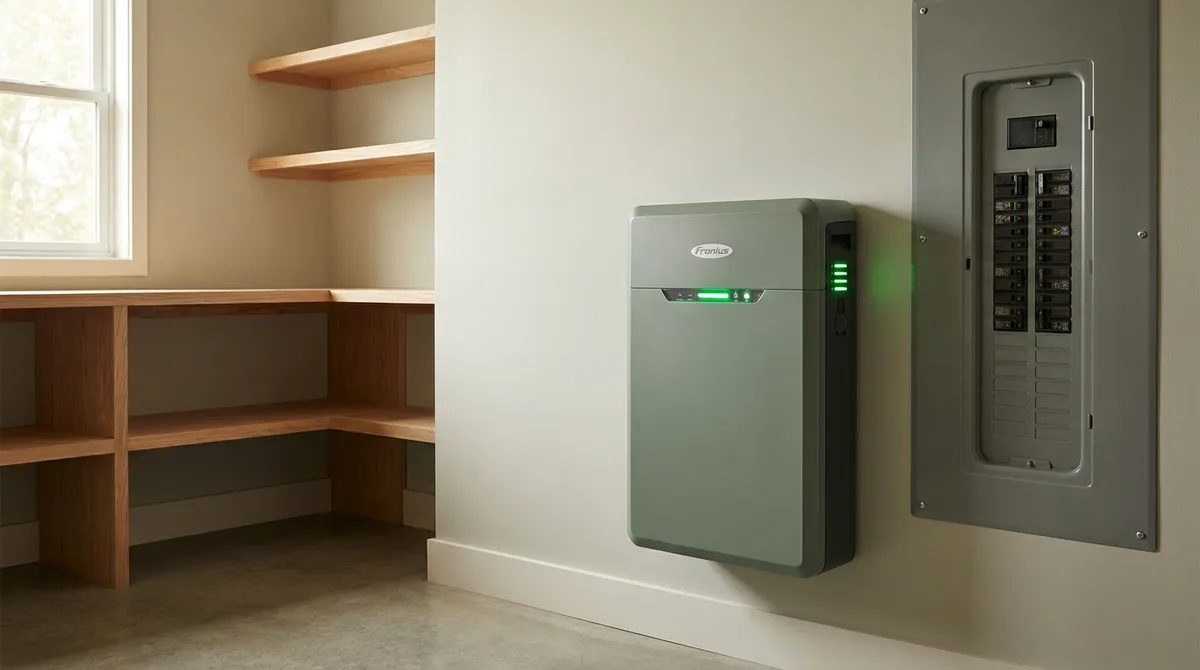
Physical battery EquipmentA real box in your home that stores the electrons. Works even during an outage if it’s designed for it. Higher initial investment.
The difference is fundamental. A physical battery actually stores your energy: you’re the owner, the gain depends on no subscription, and some models provide backup power during a grid outage. A virtual battery doesn’t belong to you, doesn’t work without the grid, and its appeal vanishes if the subscription rises or the rules change.
To size and compare a real battery, you enter a wholly different logic — capacity in kWh, technology, depth of discharge. That’s the subject of our dedicated guide, not to be confused with the virtual one.
Capacity, lithium technology, sizing based on your consumption: everything that sets real physical storage apart from an accounting credit on the grid.
Read the battery guide →Pros and cons, unfiltered
Let’s be fair: the virtual battery has genuine strengths for certain profiles.
What it has going for it
- Zero hardware, zero works: no box, no technical space, no installation.
- A low entry ticket: a few euros a month rather than an investment of several thousand euros.
- An elastic “capacity”: no physical kWh limit, within the contractual cap.
- No maintenance: nothing to replace, no cell ageing.
What should raise a flag
- Total dependence on the supplier: the rules, caps and rates can change at each contract renewal.
- No resilience: during a grid outage, you’re in the dark like everyone else.
- Residual fees: taxes and distribution fees often remain owed on the energy taken back.
- Fragile profitability: on a small surplus, the subscription can cancel out the saving.
Who it’s (really) worthwhile for
The right question isn’t “is it a good deal?” in the absolute, but “is it a good deal for me?”. A few honest benchmarks.
Rather yes, if you have a moderate surplus, no budget for a physical battery, the wish to avoid any hardware, and you’ve checked — calculation in hand — that the subscription stays below your annual gain.
Rather no, if you produce a large regular surplus (a physical battery amortises it better), if you’re aiming for independence and safety during an outage, or if the prosumer tariff and the residual fees already nibble away most of the benefit. In that case, it’s better to compare seriously with a home battery before deciding.
Add up the subscription, the per-kWh fees and the residual fees, then compare with your real saving on the energy taken back. Our overview of solar storage helps you lay down the right figures.
See all the storage options →The recap in 30 seconds
- A virtual battery stores nothing in your home — it’s a subscription service, not a piece of equipment.
- The grid acts as the battery: without a connection, the service is useless.
- Beware of “free”: subscription, caps and residual fees weigh on profitability.
- Nothing like a physical battery, which actually stores and withstands outages.
- The only arbiter: the total annual cost compared with your real gain, calculated over 12 months.
Guide verified in May 2026 · updated every year