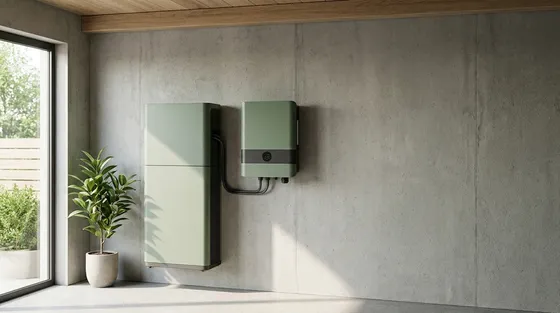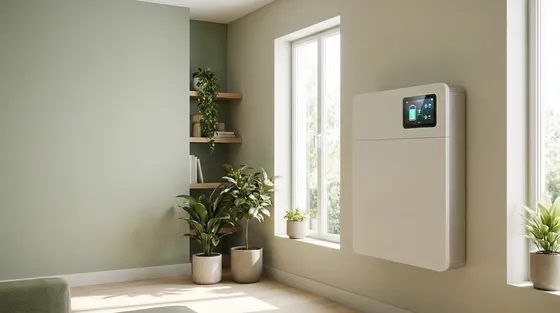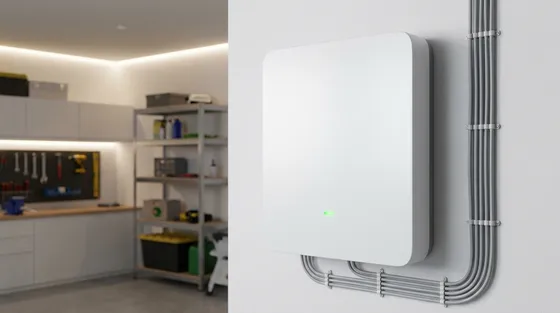


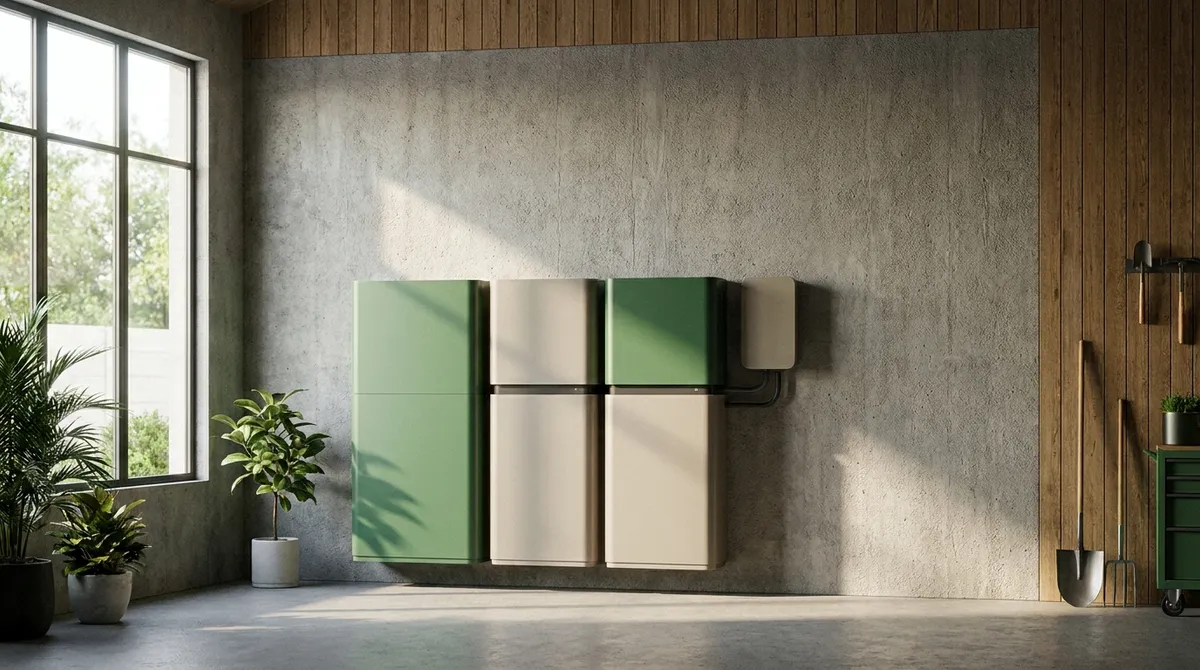
Your solar panels produce mostly at midday, when you’re often away; you consume mostly in the evening, once the sun has set. A battery bridges exactly this gap: it stores the daytime surplus to release it at night. That leaves the real question — which capacity to choose? Too small, and it empties before morning; too big, and it never fills up and weighs down your budget. This guide helps you size it right.
Why capacity is measured in kWh
A battery’s size is expressed in kilowatt-hours (kWh): it’s the amount of energy it can store. A 5 kWh battery holds enough to power a home “at rest” for a good part of the evening — lighting, appliances, router, standby devices — before handing over to the grid.
The goal isn’t to cover your entire annual consumption, nor even a whole winter day without sun. It’s to smooth out the day/night gap: capture the surplus produced in the afternoon and make it available when you get home. A residential battery targets evening and night needs, not full autonomy.
The simple sizing rule
For a first order of magnitude, a rule of thumb works very well: count roughly 1 kWh of battery for every 1,000 kWh consumed in the evening and at night. Most Belgian households thus land in a range of 5 to 10 kWh.
In practice, start from your annual consumption (visible on your bill), estimate the share consumed outside daytime hours — often about half — then bring it down to a daily figure.
Three benchmark profiles
Couple or small home, ~2,500-3,500 kWh/year, with no big electrical load in the evening.
≈ 8 kWh The typical caseFamily, ~3,500-5,000 kWh/year: the most common sizing in Belgium.
≈ 10 kWh Heavy consumerHeat pump or electric car charged overnight, high evening consumption.
Beyond 10 kWh, every extra kWh becomes harder to pay off: the battery stays partly empty most of the year. Oversizing is the most costly mistake in residential storage.
The technology: lithium LFP, now the standard
Today, nearly all serious home batteries rely on lithium iron phosphate (LFP). This chemistry has supplanted old lead-acid batteries and even lithium NMC for three reasons:
- Long lifespan — often 6,000 cycles and more, in the order of fifteen to twenty years of daily use.
- Safety — LFP is very thermally stable, with no risk of runaway as with more energy-dense chemistries.
- Depth of discharge — you can use 90 to 100 % of the rated capacity without damaging the battery, versus 50 % for lead-acid.
This depth of discharge is a key point: a 10 kWh LFP battery actually gives you close to 10 usable kWh, where an old technology would have offered only half.
This is the typical jump in self-consumption enabled by a well-sized battery: without storage, a household uses only 30 to 35 % of its production; with a battery, you commonly reach 60 to 70 %.
The inverter: hybrid or AC-coupled?
A battery never connects on its own: it talks to an inverter, which converts the current and orchestrates the flows between panels, battery, home and grid. Two setups exist.
The hybrid inverter
A hybrid inverter manages panels and battery as a single unit: the solar surplus charges the battery directly in direct current, with no double conversion. It’s the most efficient and elegant setup — to be favoured when you install panels and battery at the same time.
The AC-coupled setup
If your panels are already installed with a conventional inverter, there’s no need to replace everything: an AC-coupled battery comes with its own micro-inverter and grafts onto the existing installation. There’s a slight efficiency loss tied to the conversion, but great simplicity when adding it.
Capacity, self-consumption, prosumer tariff and budget: our simulator crosses your figures to estimate the real gain of a battery on your installation.
Estimate my profitability →Brands, warranty and cycles
The Belgian residential market is dominated by a few reliable brands — BYD, Huawei, SMA, Sonnen and Tesla in particular — which all share LFP chemistry and modular architectures. Rather than aiming for one brand in particular, look at three figures on the datasheet:
- The number of warranted cycles — 6,000 cycles or more is a good benchmark for a battery that charges and discharges every day.
- The manufacturer’s warranty — generally count on 10 years, sometimes expressed as a minimum residual capacity (for example 70 % of the initial capacity retained).
- The usable depth of discharge — check the kWh actually exploitable, not just the gross capacity advertised.
A battery that claims 10 kWh but only tolerates 80 % discharge offers you just 8 usable kWh: this detail changes the sizing.
How much it costs
For a residential LFP battery of 5 to 10 kWh, expect in the order of €4,000 to €7,000 installed, hybrid inverter included depending on the setup. The price per kWh drops as capacity rises, but that doesn’t justify buying bigger than necessary: a half-empty battery never pays for itself.
The return on investment depends on your prosumer tariff, your evening consumption and the gap between the purchase price and the resale price of electricity. That’s exactly what tailored sizing lets you optimise — and that’s why we always start from your actual bill.
Before choosing a capacity, make sure storage is profitable in your case: this guide weighs the pros and cons depending on your profile.
Read the profitability guide →How to choose YOUR capacity, step by step
To go from ranges to your figure, follow four simple steps.
- Note your annual consumption on your bill, in kWh.
- Estimate the evening and night share — often half, more if you heat or charge a car in the evening.
- Apply the rule of roughly 1 kWh of battery per 1,000 kWh consumed outside daytime hours.
- Cross-check with your production: a battery is only useful if your panels generate enough surplus to fill it.
One last safeguard: a battery only makes sense if your installation produces a steady surplus. If your panels are undersized, it’s the production you need to revisit first.
“The best battery isn’t the biggest one: it’s the one that empties every evening and fills up every day.
A battery installer confirms this calculation on site in a few minutes, by reading your actual consumption curve rather than a theoretical average.
The 30-second recap
- Capacity — about 1 kWh per 1,000 kWh consumed in the evening; 5 to 10 kWh for most households.
- Technology — lithium LFP is the standard: long lifespan, safe, high depth of discharge.
- Inverter — hybrid if everything is new, AC-coupled to add a battery to existing panels.
- Gain — self-consumption commonly rises from 35 % to 70 % with well-sized storage.
- Budget — in the order of €4,000 to €7,000 installed; never oversize “for the reserve”.
Guide reviewed in May 2026 · updated every year