

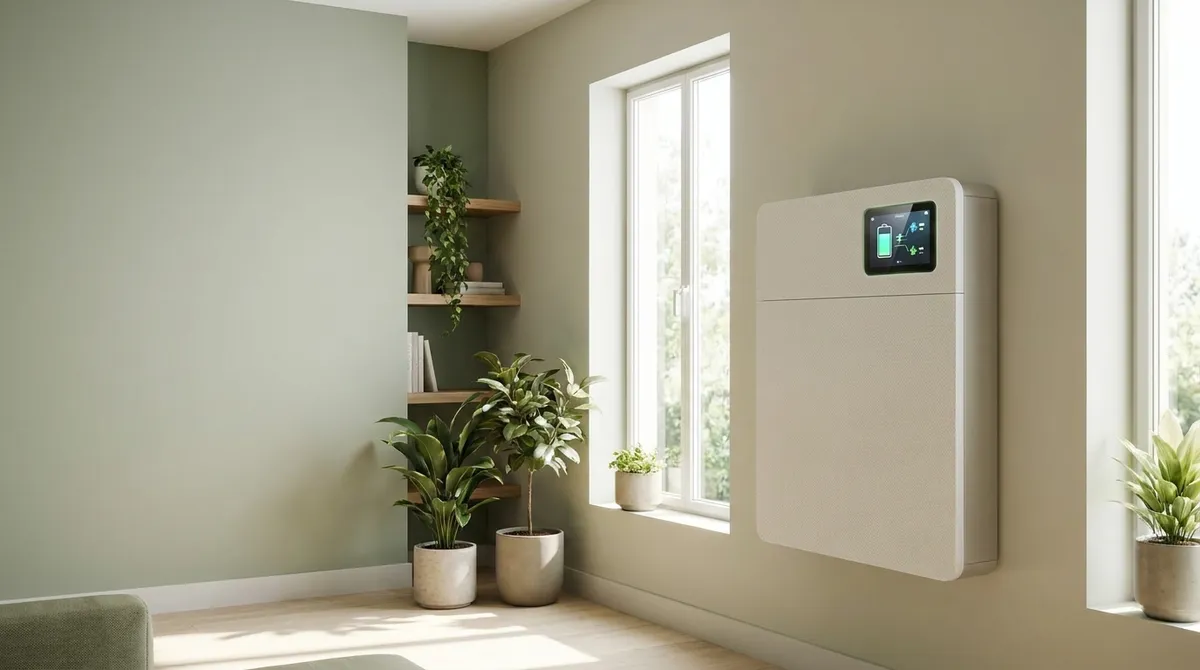
Your panels produce the most electricity in the middle of the day — precisely when the house is often empty. In the evening, when everyone comes home and consumption climbs, the sun sets. Energy storage solves exactly this mismatch: it sets aside the midday surplus to release it when you need it. This guide lays the foundations — why store, with which technology and according to which key concepts — before going into detail with our specialised guides.
Why store your electricity?
For years, the meter running backwards made the battery almost pointless: all the surplus injected into the grid was deducted from what you drew back, as if the grid served as a free reserve. This mechanism is gradually disappearing. From now on, the surplus you inject is bought back from you at a far lower price than the one at which you buy your electricity in the evening.
This is where everything is decided. The more you consume your own production directly, the less expensive electricity you buy from the grid. This indicator has a name: the self-consumption rate. Without a battery, a household equipped with solar panels consumes directly about a third of what it produces. With well-sized storage, this rate can comfortably exceed half, sometimes more depending on the consumption profile.
Storing therefore means turning midday production — poorly valued if it goes back to the grid — into evening electricity that you don’t have to buy. It is the number one lever of modern self-consumption.
This is the typical round-trip efficiency of a modern lithium battery: out of 100 kWh stored, you recover around 90 at the output. The remaining 10% are the inevitable losses of charging and discharging.
Storage technologies
Not all batteries are equal, and the residential market has become much clearer in recent years. Three approaches deserve to be distinguished — two physical chemistries and one purely contractual approach.
Lithium iron phosphate: long lifespan, deep discharge, high thermal safety. The benchmark for residential use.
Virtual battery No hardwareYour surplus is credited by a supplier and given back later, with no unit in your home.
Lead-acid ObsoleteHeavy, low depth of discharge, short lifespan. To be avoided for domestic solar use.
Lithium iron phosphate (LFP)
This is today the benchmark technology for home storage. Lithium iron phosphate offers a long lifespan (several thousand cycles), a significant depth of discharge, good efficiency and above all great thermal stability — a decisive safety advantage when the unit lives in your home, sometimes in a garage or utility room. Most of the serious residential brands have switched to this chemistry.
Lead-acid, an outdated technology
Lead-acid batteries, long used in off-grid sites, no longer have a place in a modern domestic solar installation. They are heavy, cope poorly with deep discharges, age quickly and require maintenance. For equal usable capacity, the overall cost over the lifespan tips very clearly in favour of lithium.
The virtual battery
Alongside physical batteries exists a different approach: the virtual battery. Here, there is no unit in your home. The surplus you inject is recorded by a supplier, who “gives it back” to you later as grid electricity, according to the terms of a contract. It is a solution with no hardware investment, with its own calculation rules and limits — a topic in its own right.
How it works, hidden costs and use cases: everything you need to know before signing up for a virtual battery rather than a physical unit.
Understand the virtual battery →The key concepts to master
Comparing two batteries without understanding their datasheet leads straight to mistakes. A few concepts come up systematically — here they are, explained simply.
Capacity (kWh) and power (kW)
These are two different things that are often confused. Capacity, expressed in kilowatt-hours (kWh), is the size of the tank: how much energy the battery can store. Power, in kilowatts (kW), is the flow rate: how fast it can charge or supply your home. A battery with a large capacity but low power empties slowly; the two need to be consistent with your usage.
Depth of discharge (DoD)
The depth of discharge (DoD) indicates what share of the capacity is actually usable. A 10 kWh battery with 90% DoD does not give you 10 kWh, but 9 kWh usable; the rest is kept in reserve to preserve longevity. LFP allows high DoD, which partly explains its appeal. It is the usable capacity — not the gross capacity — that should be compared.
Cycles and lifespan
A cycle corresponds to a full charge followed by a full discharge. A battery’s warranty is often expressed as a number of cycles (for example 6,000) or in years. Since you roughly carry out one cycle a day, this figure translates directly into lifespan. It is a central criterion for comparing the real cost over the long term.
Round-trip efficiency
Round-trip efficiency measures the energy recovered compared with the energy stored. At around 90% for modern lithium, it is a reminder that no storage is free in energy terms: there is always a small loss on charging and discharging. Good efficiency limits this waste.
Sizing your storage: the principle
There’s no need to aim for the biggest battery on the market. Good sizing starts from your evening and night consumption — the share your panels don’t cover directly. It is precisely that energy a battery should be able to store during the day to give it back to you later.
A battery that is too big will never fill completely: you pay for capacity that lies dormant. A battery that is too small will let surplus go back to the grid, at a low price. The goal is balance, and it depends on your production, your habits and the possible presence of an electric car or a heat pump. In residential use, many households fall around 5 to 10 kWh of usable capacity, but this benchmark does not replace a study of your real profile.
Usable capacity, power, brand and warranty in cycles: the complete method for matching the battery to your installation, with concrete benchmarks.
See the buying guide →Safety and installation
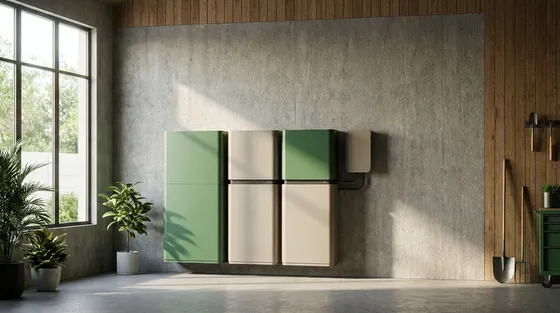
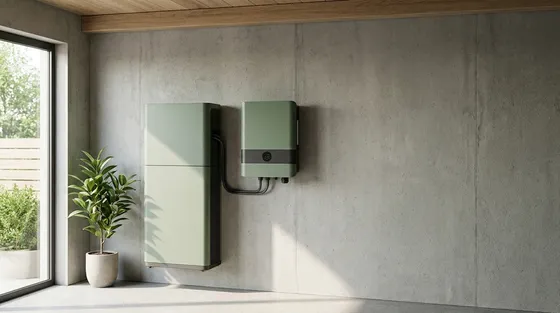
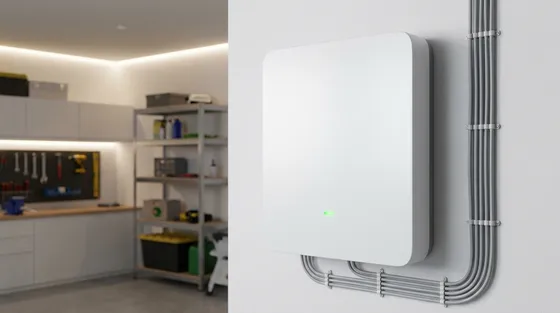
The safety of a home battery comes down to three things: a stable chemistry (LFP ticks this box), an electronic management system — the BMS — that constantly monitors temperature, voltage and current, and a compliant installation carried out by a professional. It is this last point that makes the difference: a branded unit poorly installed remains a risk, whereas a careful installation makes the whole system very reliable. The location (ventilation, temperature, access) is also chosen with care.
And tomorrow? V2H and smart control
Residential storage will soon no longer be limited to the wall-mounted unit. V2H (vehicle-to-home) makes it possible to use your electric car’s battery as a reserve for the house — a considerable capacity already parked in the garage. In parallel, smart control orchestrates production, battery, water heater and vehicle charging to consume at the best moment and take advantage of dynamic tariffs. These developments further reinforce the value of thinking about storage today.
The 30-second recap
- Storing serves to consume in the evening what your panels produce at midday — the engine of self-consumption.
- Lithium LFP is the residential standard; lead-acid is obsolete.
- Four key concepts: capacity (kWh), power (kW), DoD and cycles.
- Round-trip efficiency hovers around 90%: a little energy is always lost.
- You size on evening consumption, not on the biggest battery possible.
Guide verified in May 2026 · updated every year