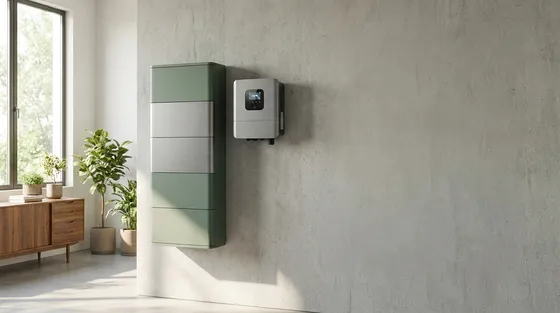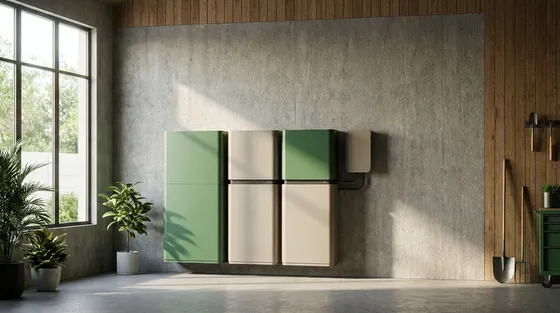


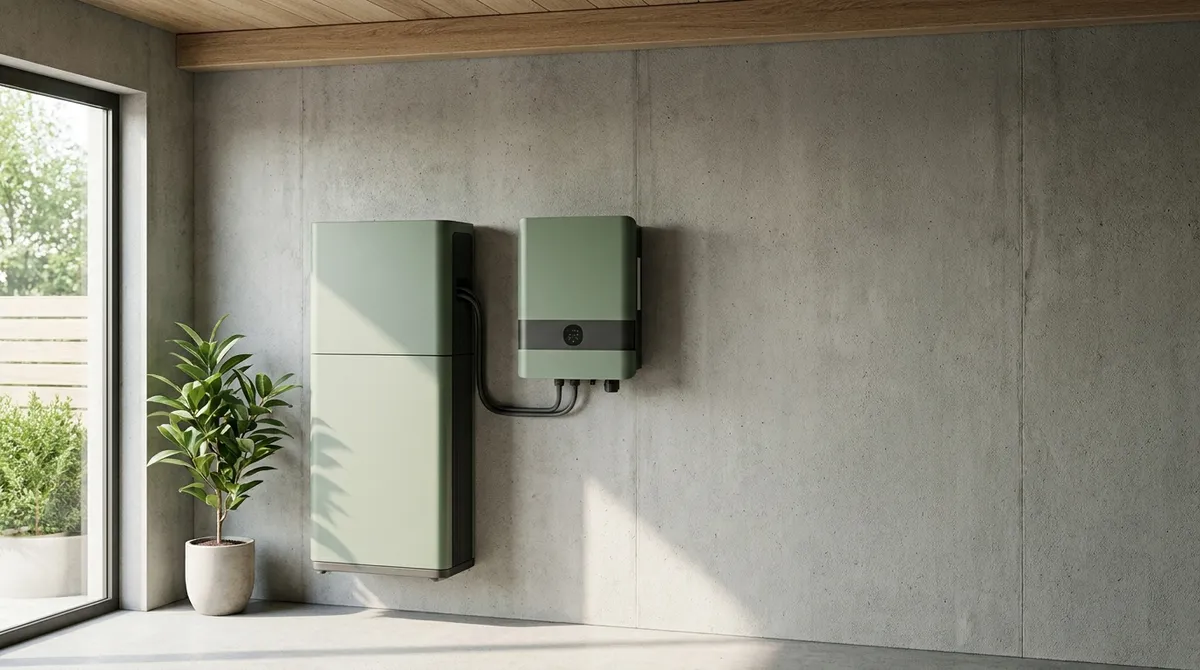
Your solar panels produce the most in the middle of the day — precisely when the house is often empty. Come evening, when you cook, watch TV and recharge your devices, they no longer produce anything. The battery answers this mismatch: it sets aside the day’s surplus to give it back to you at night. Appealing on paper — but the investment only makes sense for certain profiles. This guide helps you find out whether yours is one of them.
What a solar battery is for
Without a battery, the electricity your panels produce and that you don’t consume immediately goes back to the grid. You “sell” it at an injection rate, generally far lower than the price at which you’ll buy electricity back in the evening. The battery breaks this bad exchange: it stores your midday surplus to spare you from buying back at the full price a few hours later.
In concrete terms, it fulfils three functions:
- Increasing your self-consumption — the share of your own production that you actually consume, instead of injecting it.
- Reducing your dependence on the grid — you draw first from your battery before buying electricity.
- Providing backup during an outage — but only on models fitted with a backup function, wired for it.
Without storage, a household self-consumes on average around 35% of its solar production. With a well-sized battery, this share often climbs to around 70%: that is the whole point of storage.
The real benefits
The main benefit is financial and indirect: every kilowatt-hour you store and then consume in the evening is a kilowatt-hour you don’t buy from the grid. The greater the gap between the purchase price of electricity and the rate at which you would inject it, the more the battery works for you.
Then come comfort benefits. You gain in autonomy: a greater share of your energy becomes your own, produced on your roof, sheltered from market price swings. And with a backup function, you can keep a few essential circuits running — lighting, fridge, internet router — during a power outage, something a solar installation alone cannot do.
The drawbacks to face squarely
A battery remains a substantial investment. Expect €4,000 to €7,000 installed for a common residential model, a budget of the same order as part of the solar installation itself.
A payback time that stretches out
Since the battery saves a few hundred euros a year at best, its payback time is counted in years — often more than that of the panels alone. Over the lifetime of a battery, the calculation can remain favourable, but it is less clear-cut than for pure photovoltaics.
A capacity that must be sized
Too small, and the battery empties before the end of the evening and you buy back electricity anyway. Too large, and it never fully charges and you have overpaid for unused kilowatt-hours. The right sizing starts from your actual evening consumption, not from the biggest model in the catalogue.
Our simulator combines your production, your consumption profile and your electricity rate to estimate what a battery would actually earn you.
Estimate my profitability →Who a battery is right for
The profile matters more than the technology. A battery is worthwhile when your consumption is shifted relative to your solar production.
It makes sense if:
- you are away during the day (work, school) and consume mostly in the morning and evening;
- you have a high evening consumption — electric cooking, vehicle charging, evening appliances;
- the injection rate for your surplus is low, which makes self-consumption far more profitable than selling back;
- autonomy or backup during an outage matters to you, beyond the purely financial calculation.
Who it is less right for
Conversely, storage brings little if your consumption already matches your production closely.
That’s the case if:
- you consume mostly during the day (remote work, presence at home), so you already self-consume most of it without storing anything;
- your overall consumption is modest, which mechanically reduces the possible savings;
- your solar installation is small and produces little surplus to set aside;
- your budget is tight and better spent on enlarging the panel array, whose return is faster.
“The best battery is sometimes the one you don’t buy — replaced by a slightly larger panel array or by good consumption habits.
The alternatives to a physical battery
Before investing, two avenues are worth weighing, because they meet the same need — making better use of your surplus — without buying equipment.
Shifting your usage
This is the free and often underestimated option. Programming the washing machine, dishwasher, water heater or car charging for the middle of the day amounts to self-consuming directly, without going through a battery. For many households, a little discipline and a few timers are enough to raise self-consumption noticeably.
The virtual battery
Some suppliers offer to “credit” your injected surplus to give it back to you later, in exchange for a subscription. No hardware, no clutter — but conditions and a monthly cost to study closely, and a service that depends entirely on the supplier. It’s an alternative to compare, not an obvious choice.
How to decide for your home
There’s no point looking for a universal answer: the right decision depends on your roof and your habits. Three reflexes to decide with peace of mind.
First, observe your actual consumption. Ideally, install the panels, live with them for a year, then decide: you’ll know exactly how much you consume in the evening and how much surplus goes to the grid. A battery can perfectly well be added afterwards, provided you plan for a compatible inverter.
Next, compare the figures with your own situation, rather than with an average. The same equipment can be profitable at your neighbour’s and superfluous at your home, depending on your hours and your rate.
Finally, have the gain estimated before signing. The home battery is a fine project, but it’s a calculation, not a trend: better to put it down in black and white.
The recap in 30 seconds
- A battery stores the day’s surplus to consume it in the evening and at night.
- It raises self-consumption from around 35% to nearly 70% when well sized.
- Expect €4,000 to €7,000 and a payback time counted in years.
- Worthwhile if you’re away during the day and consume a lot in the evening; less useful if you consume mostly during the day.
- Before investing, weigh the alternatives: shifting your usage, or the virtual battery.
Guide verified in May 2026 · updated every year