

If you installed solar panels a few years ago, you probably enjoyed the comfort of the meter running backwards: every kilowatt-hour fed into the grid cancelled out a kilowatt-hour drawn, with no complicated maths. That mechanism, simple and generous, is on its way out. Understanding what replaces it is essential to properly size — and properly recoup the cost of — an installation today.
What it was: the 1:1 offset
The principle relied on the old electromechanical meter, the one with a rotating disc. When your panels produced more than you consumed, the surplus went back onto the grid and literally made the meter turn in reverse. At the end of the year, you were only billed the difference between what you had drawn and what you had fed in.
In practice, the grid played the role of a free and unlimited battery: you stored your summer surplus there to recover it in winter, at a perfect one-for-one exchange rate. Electricity fed in was worth exactly as much as electricity purchased. It was unbeatable — and, for the grid operator, untenable on a large scale.
Why it changed
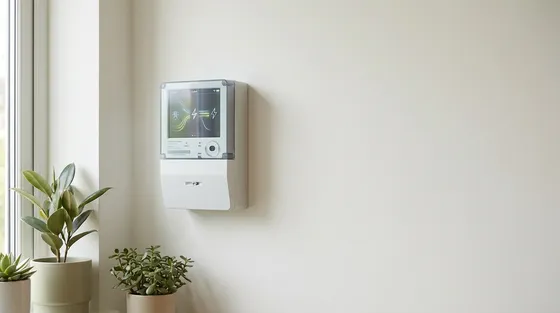
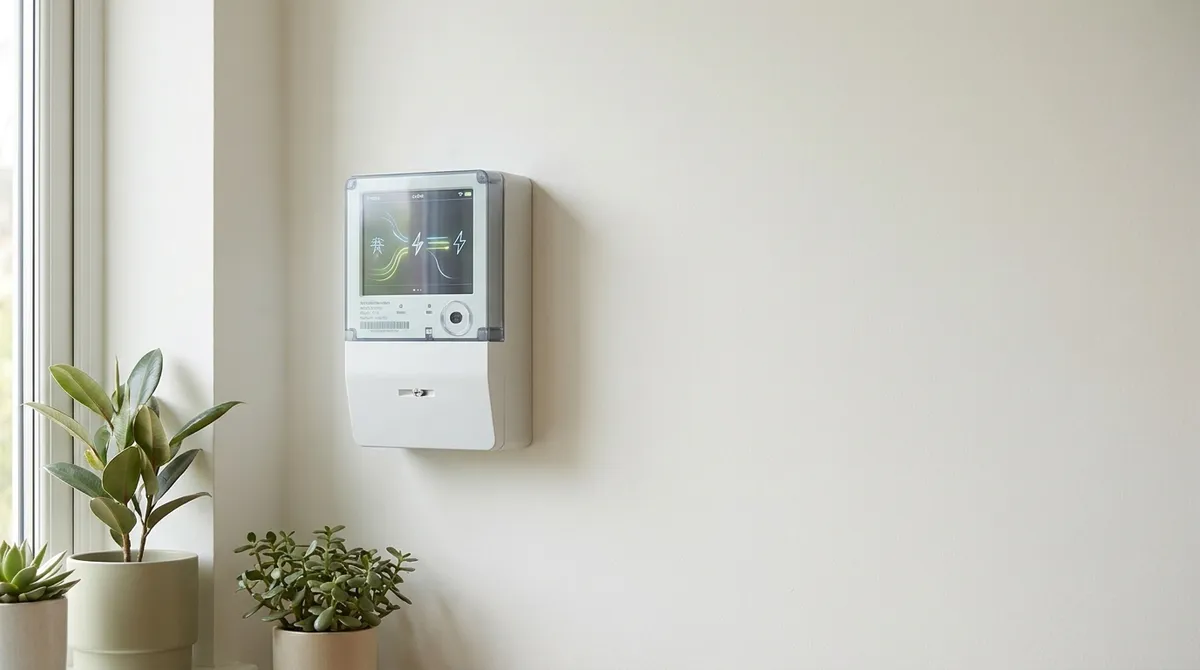
Two developments brought this arrangement to an end. First, the rollout of two-way smart meters (the “intelligent” meters). Unlike the mechanical meter, they measure separately the energy coming into your home and the energy going out. From then on, automatic subtraction no longer has any reason to exist: each flow is known precisely.
Second, an economic and technical reality. With the proliferation of installations, the grid could no longer serve indefinitely as a free reservoir: maintaining cables and transformers and managing feed-in peaks come at a very real cost. The 1:1 offset shifted that cost onto the community. Removing it, together with the prosumer tariff, aims to make producers contribute to the upkeep of the grid they use in both directions.
This was the exchange rate of the backwards meter: one kWh fed in cancelled one kWh drawn. Today that ratio is broken — feed-in is worth far less than draw.
What applies now
From now on, your two flows each have their own price, and the gap is significant.
Feed-in is poorly valued
The electricity you send back onto the grid is bought back by your supplier at a feed-in tariff which, in 2026, hovers around 0.05 €/kWh depending on the contract. That is not nothing, but it bears no comparison with the value that same kilowatt-hour would have had if you had consumed it yourself.
Draw remains expensive
Conversely, the electricity you buy from the grid costs around 0.35 €/kWh, all components included (energy, grid, taxes). In other words, every kWh you produce and consume on site saves you about 0.35 €, while that same kWh fed in earns you only about 0.05 €. The ratio is on the order of seven to one in favour of self-consumption.
The prosumer tariff in Wallonia
In Wallonia, producers pay a prosumer tariff for use of the grid. Two calculation methods coexist: a flat rate based on the installed capacity (in kWp), or pricing according to the actual flows measured by the two-way meter. This choice deserves thought: a household that self-consumes a lot often benefits from the proportional tariff, whereas a heavily exporting profile may prefer the flat rate. The exact terms and amounts change and should be checked case by case.
Feed-in tariff, electricity price, prosumer tariff and self-consumption share: the simulator combines all these parameters to estimate the real return on your installation, region by region.
Estimate my profitability →The consequence: self-consumption becomes the key
Everything flows from the gap between the two prices. Under the backwards meter, the time at which you consumed was irrelevant: the grid smoothed everything out. Today, the moment when you use your electricity radically changes the result.
Running your dishwasher, your washing machine or charging your car in the middle of the day, when the panels are producing, turns a 0.05 € kWh (fed in) into a 0.35 € kWh (saved). It is the most powerful — and free — lever for recouping a modern installation. Shifting your usage, controlling your large appliances and aiming for a high self-consumption rate has become the central challenge.
Scheduling your appliances, heating your water at the right time, controlling your charging: the concrete habits that raise the share of energy consumed on site.
Read the self-consumption guide →Wallonia, Flanders: different frameworks
The end of the backwards meter did not unfold at the same pace everywhere, because energy is a regional competence.
In Flanders, the switch was early and clear-cut: since the rollout of digital meters, the 1:1 offset has been removed for new installations, which operate on a two-way basis with feed-in valued separately.
In Wallonia, the transition happened more gradually, with the introduction of the prosumer tariff and the staggered rollout of two-way meters. Recent installations fall under the new regime, and the choice between flat-rate and proportional pricing remains a specific point of attention there.
In both cases, the underlying logic is identical: you no longer store on the grid for free, and self-consumption takes priority. Since these frameworks evolve, it is best to confirm the rules applicable to your municipality before pricing a project.
The impact on profitability
Should we conclude that solar is no longer profitable? Quite the opposite. An installation remains an excellent investment — it is simply that profitability is no longer built the same way. Yesterday it rested on the offset; today it rests on the saving achieved on every self-consumed kWh, multiplied by an electricity price that remains high.
The right reflex has therefore changed. You no longer aim to oversize in order to “feed in as much as possible”, but to size correctly and consume as much of your own production as you can. To assess this precisely, the best approach is to start from your real profile via the profitability simulator, or to go back to basics on the solar panels page.
Where the battery makes sense again
This is precisely the renewed appeal of storage. Under the backwards meter, a battery had little financial use: the grid already played that role for free. Now, storing your midday surplus to release it in the evening avoids the double trap — feeding in at 0.05 € then buying back at 0.35 €. The battery converts that poorly valued surplus into energy consumed at full avoided price.
It is not essential for every household: its value depends on your consumption curve, the size of the installation and your budget. The guide dedicated to the battery and the question of the prosumer tariff will help you decide with full knowledge of the facts.
The 30-second recap
- The backwards meter (1:1 offset) is over for new installations.
- Two-way meters count feed-in and draw separately.
- Feed-in ≈ 0.05 €/kWh versus purchase ≈ 0.35 €/kWh: the gap changes everything.
- In Wallonia, the prosumer tariff pays for use of the grid (flat rate or actual flows).
- Self-consuming has become lever No. 1 — and the battery regains its full purpose.
Framework verified in May 2026 · to be confirmed depending on your region