

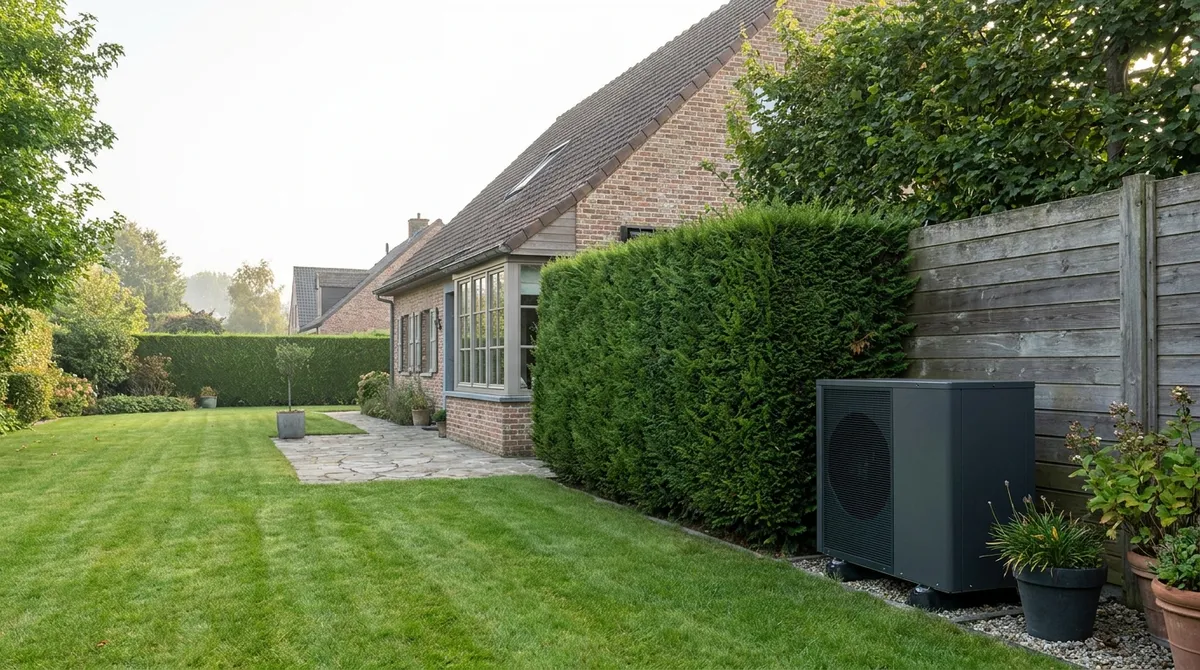
“But what about the noise?” It is one of the first questions asked before installing a heat pump. The reputation of old units — whistling and vibrating — still clings to the technology. Yet today’s models have little in common with them: well chosen and well installed, they fade into the background. This guide sorts the inherited fears from the measured reality, and gives you the right reflexes for an installation without nuisance.
Where does a heat pump’s noise come from?
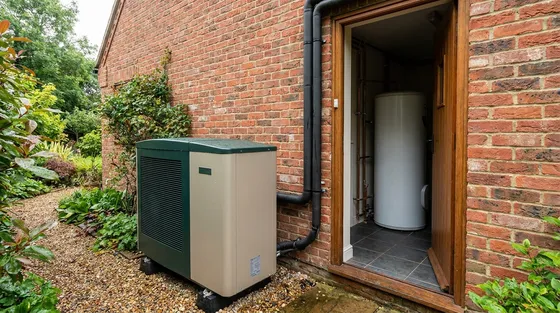
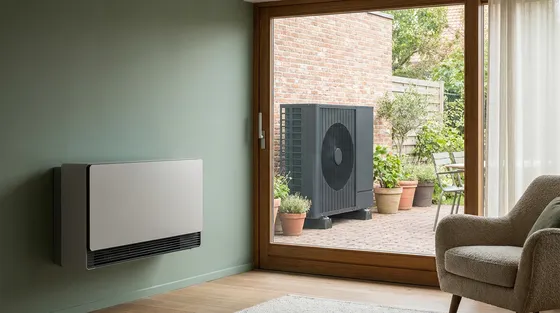
An air-source heat pump captures heat from the outside air through an outdoor unit. This is what produces most of the noise, from two main sources: the fan that moves the air, and the compressor that pressurises the refrigerant. Indoors, the hydraulic module of an air-water system is almost silent; only air-air heat pumps emit a slight airflow sound at the splits.
Noise travels in two ways: through the air (the airflow and hum you hear) and through vibrations (transmitted to the wall or ground if the unit is poorly mounted). The two are treated differently, and that is precisely where acoustic comfort is won.
How many decibels, in concrete terms?
This is the heart of the matter. A modern outdoor unit sits in a moderate range, which drops quickly as soon as you move away.
This is the typical sound level of an outdoor unit measured a few metres away. For reference: a fridge runs around 40 dB(A), a quiet conversation around 45, a calm room at night around 30. We are very far from a nuisance.
Two important points. First, the decibel follows a logarithmic scale: the perceived level drops quickly with distance, by a few decibels each time you double the gap. Second, manufacturers often quote a sound power level (Lw, measured at the source, higher) and a sound pressure level (Lp, what the ear perceives at a distance, lower): you have to compare figures of the same kind, and always check at what distance the value is stated.
What Belgian regulations say
There is no single federal threshold imposing a fixed distance from the neighbour. It is the neighbourhood noise rules, which fall under the Regions and sometimes the municipalities, that govern the installation. The principle is the same everywhere: the unit must not create abnormal disturbance, assessed at the sound level measured at the property boundary or at the windows of neighbouring homes, with stricter thresholds at night than during the day.
In practice, this means you reason in terms of outcome (the level perceived at the neighbour’s) rather than a theoretical distance. A planning permit may also be required depending on the municipality and the unit’s location. Before any installation, it is therefore best to check the local rules — a step we take care of.
The right location and the anti-vibration supports are decided during the study, not afterwards. It is the simplest — and cheapest — way to avoid any neighbour dispute.
See heat pump installation →The factors that change everything
For the same output, two installations can offer very different acoustic comfort. Three levers make the difference.
The quality of the equipment
Not all models are equal. Recent ranges refine the fan’s aerodynamics, insulate the compressor compartment and run at variable speed (Inverter technology) rather than all-or-nothing. The result: fewer noise peaks and steadier operation. The spec sheet states a sound level — it is a selection criterion in its own right.
The night or quiet mode
Almost all modern heat pumps include a programmable quiet mode. It lowers the fan speed and limits the compressor during sleeping hours, at the cost of a slight drop in output — with no impact on heating comfort, since the night is often the least demanding period.
The location
This is the most decisive factor, and the least costly. The same unit placed under a bedroom window or in a corner where noise reverberates will be far more disturbing than one set in a ventilated open space, away from sensitive openings.
Positioning the outdoor unit well
A few simple rules are enough to resolve most situations:
- Keep it away from bedrooms, your own and the neighbours’ — avoid façades with night-time windows.
- Move away from party boundaries and do not direct the airflow towards the neighbouring property.
- Avoid corners and recesses that act as a resonance box; favour an open, well-ventilated location.
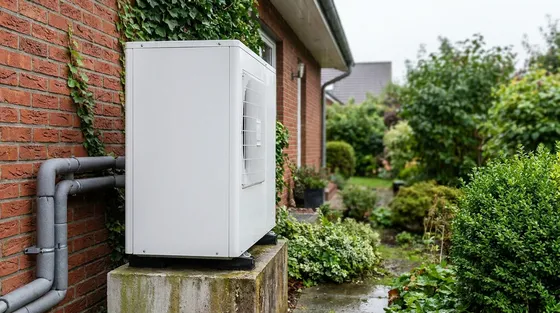
- Decouple the unit from the structure with anti-vibration mounts or a base, to cut the transmission of vibrations to the wall and ground.
The anti-noise solutions that work
If a sensitive point remains, several proven answers exist, to be scaled to the need:
- Anti-vibration supports (mounts, silent blocks, a decoupled base): the first line of defence, often enough, against transmitted vibrations.
- Acoustic screen or absorbing partition: a well-placed panel cuts the direct propagation of noise towards the neighbour or a window.
- Acoustic enclosure: an absorbing shell around the unit, provided you preserve the airflow it needs for its efficiency.
- Quiet mode activated during sensitive time slots, to complement the physical solutions.
The key is to diagnose the real cause (vibration or airborne noise?) before investing: a vibration cannot be treated with a screen, and vice versa.
Debunking an outdated reputation
The fear of noise comes mainly from installations of fifteen or twenty years ago. Today’s heat pumps have made considerable progress on acoustics: Inverter compressors, profiled fans, widespread night modes. Well chosen, well installed and well maintained, a heat pump blends into a garden’s soundscape. Regular maintenance also helps preserve that quiet: a clogged fan or a worn support eventually makes itself heard.
The key takeaways
- A modern outdoor unit runs around 35-50 dB(A) a few metres away — the equivalent of a fridge.
- No single federal distance: it is the regional and municipal neighbourhood noise rules that apply.
- The equipment, the quiet mode and above all the location make all the difference.
- Anti-vibration mounts, a screen, an acoustic enclosure and good positioning settle most situations.
- Today's heat pumps are significantly quieter than fifteen years ago: the bad reputation is outdated.
Guide reviewed in May 2026 · updated every year