

When you compare solar panel quotes, one word comes up again and again: monocrystalline. Sometimes facing its cousin, polycrystalline. These two terms refer to how the silicon cell at the heart of the panel is made — and this technical detail decides the efficiency, the colour and the price. Good news: in 2026, the choice has become markedly simpler than it was ten years ago. This guide explains why.
Mono, poly: what are we talking about?
A solar panel is an assembly of photovoltaic silicon cells. It’s the way this silicon is crystallised that distinguishes the two historic families.
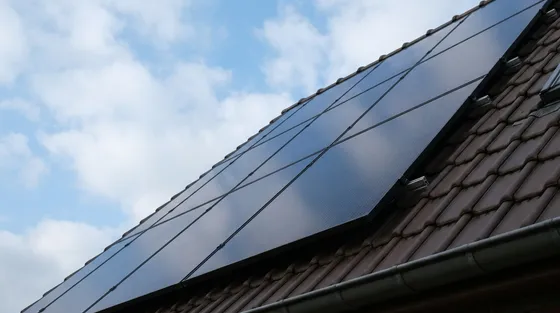
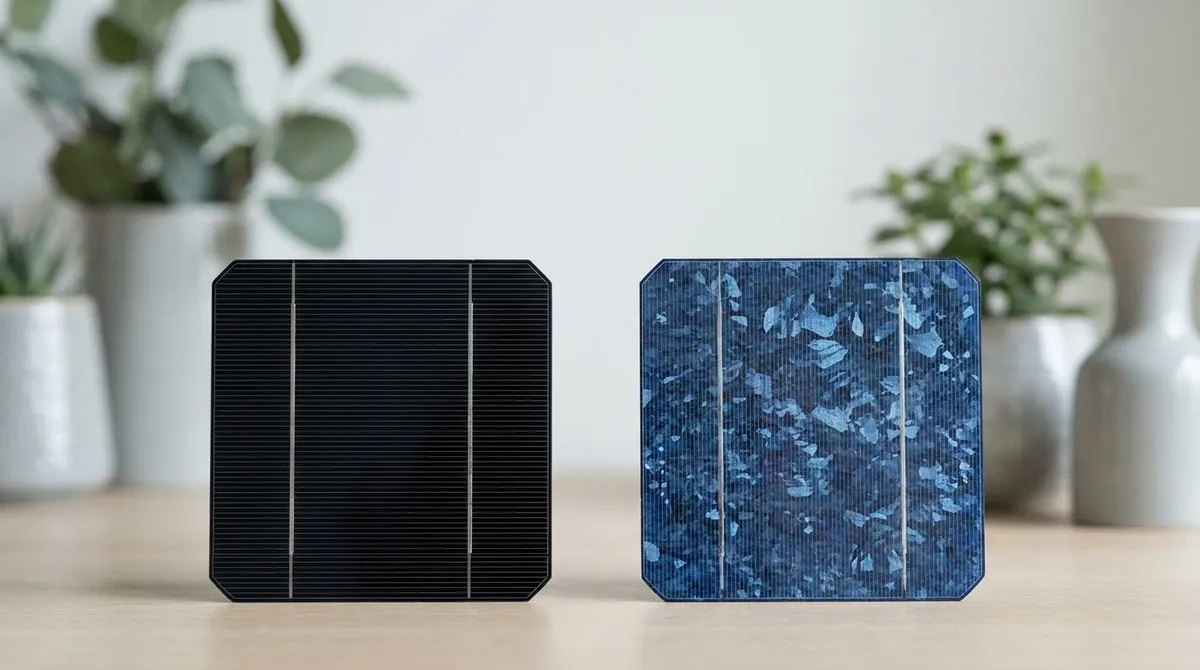
Monocrystalline is cut from a silicon ingot formed of a single continuous crystal. This regular structure lets the electrons move freely: efficiency climbs, and the cell takes on a uniform black hue, with often bevelled corners.
Polycrystalline (or multicrystalline) is obtained by melting several pieces of silicon that solidify together. You can see bluish reflections and a “frosted” look with the naked eye: these multiple crystals slightly slow the electrons, hence a more modest efficiency, but a historically lower manufacturing cost.
Black cell from a single crystal. Efficiency ~20–22%, excellent in low light. The default choice today.
Polycrystalline On the way outBluish multicrystalline cell. Efficiency ~15–17%, cheaper in the past, increasingly rare in new projects.
Recent technologies Mono evolutionsPERC, half-cells, bifacial, TOPCon: refinements of monocrystalline that push efficiency beyond 22%.
Efficiency: the gap that changes everything
Efficiency is the share of received solar energy that a panel turns into electricity. The higher it is, the more you produce on the same roof surface — a crucial point in Belgium, where we often reason in available square metres rather than unlimited budget.
- A modern monocrystalline panel sits around 20 to 22% efficiency.
- A polycrystalline panel tends to top out around 15 to 17%.
Five points of difference may seem trivial. In practice, they mean that to produce the same amount of electricity, a polycrystalline installation requires more panels, hence more roof surface. On a compact or partially shaded roof, monocrystalline often makes it possible to reach the target where polycrystalline wouldn’t manage.
That’s the typical efficiency of a monocrystalline panel sold in 2026, against 15 to 17% for polycrystalline. For the same surface area, that represents several hundred extra kWh produced each year on a domestic installation.
And under grey skies?
In the Belgian climate, diffuse light counts as much as full sun. Monocrystalline keeps a slight advantage here: its structure captures light a little better in low conditions. The gap stays modest day to day — orientation, tilt and the absence of shading weigh far more heavily on annual production. But with comparable equipment, mono starts with a head start.
Price: an argument that has collapsed
For a long time, polycrystalline held on thanks to its price: cheaper to make, it equipped installations seeking to reduce the initial cost. That argument has all but disappeared.
Worldwide production of monocrystalline silicon has grown so much that its cost has plummeted. Today, the price gap between a mono panel and a poly panel of equivalent power has become negligible — when it still exists at all. Manufacturers have logically concentrated their lines on monocrystalline, more efficient and now just as affordable.
Price ranges by power (kWp), factors that make the quote vary and regional grants: the real budget of an installation, backed by figures.
See prices and grants →Result: paying more for polycrystalline no longer makes sense, and paying “less” for poly often saves only a few percent — at the cost of lower efficiency over twenty-five years. The calculation tilts clearly towards monocrystalline.
Why monocrystalline has taken over
The market’s shift isn’t a fad, but the sum of three advantages that have become decisive:
- Better efficiency on an always-limited roof surface.
- A price aligned with that of polycrystalline, or even lower depending on the range.
- Better behaviour in low light and, on recent versions, in high heat.
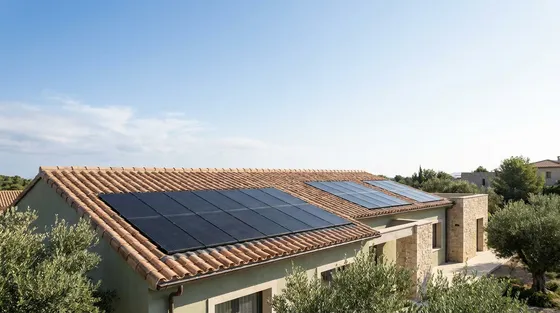
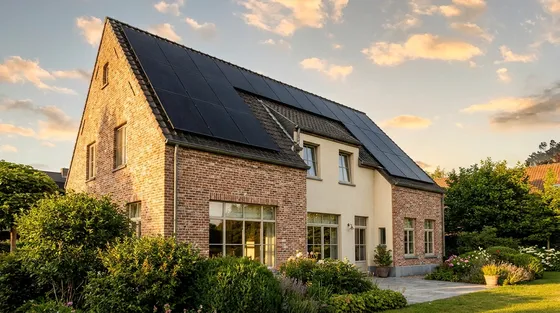
To these qualities is added the aesthetic aspect: the uniform black of monocrystalline blends more discreetly into a roof than the speckled blue of polycrystalline, a criterion that matters more and more for façades visible from the street.
“In 2026, choosing between mono and poly is no longer about weighing a trade-off: it’s about noting that monocrystalline has simply taken over the whole space.
Beyond mono: PERC, bifacial, TOPCon
The “mono or poly” debate masks one reality: innovation now plays out within the monocrystalline family. Several refinements equip recent panels.
PERC and half-cells
PERC technology adds a reflective layer at the back of the cell to recover light that had passed through it. Half-cells (half-cut) split each cell in two, which reduces electrical losses and improves behaviour in case of partial shading. These two processes are today almost systematic.
Bifacial and TOPCon
Bifacial panels also capture the light reflected by their back face — useful on a light-coloured roof or a ground installation. TOPCon technology, for its part, pushes efficiency beyond 22% with better heat resistance. These are the spearheads of the high-end ranges of 2026.
Should you absolutely insist on them? On a typical residential roof, the real gain stays moderate. Better to aim for a recent and serious monocrystalline panel, well sized and well fitted, than a spectacular datasheet poorly exploited. It is in fact the quality of the study and the installation that makes the difference in real production.
In practice: what to choose?
For a new project in 2026, the answer fits in one line: monocrystalline, almost always. Polycrystalline is no longer justified except on possible clearance stocks or very particular cases, and the savings made are generally wiped out by the efficiency loss over the lifespan of the installation.
The real question is therefore no longer “mono or poly”, but: what power to install, with which brand, and under what production warranty over time. That is where the real profitability of your installation is decided, far more than in the type of crystal.
How they work, efficiency, sizing, price and grants: the Wendows solar pillar gathers everything you need to know before getting started.
Discover the complete guide →The 30-second recap
- Monocrystalline — black cell, efficiency ~20–22%, better in low light: the 2026 standard.
- Polycrystalline — bluish cell, efficiency ~15–17%, cheaper in the past, now on the way out.
- The price gap between the two has collapsed: mono is now just as affordable.
- PERC, bifacial, TOPCon are evolutions of monocrystalline, not another family.
- For a new project, the choice is simple: monocrystalline, almost always.
Guide verified in May 2026 · updated every year