

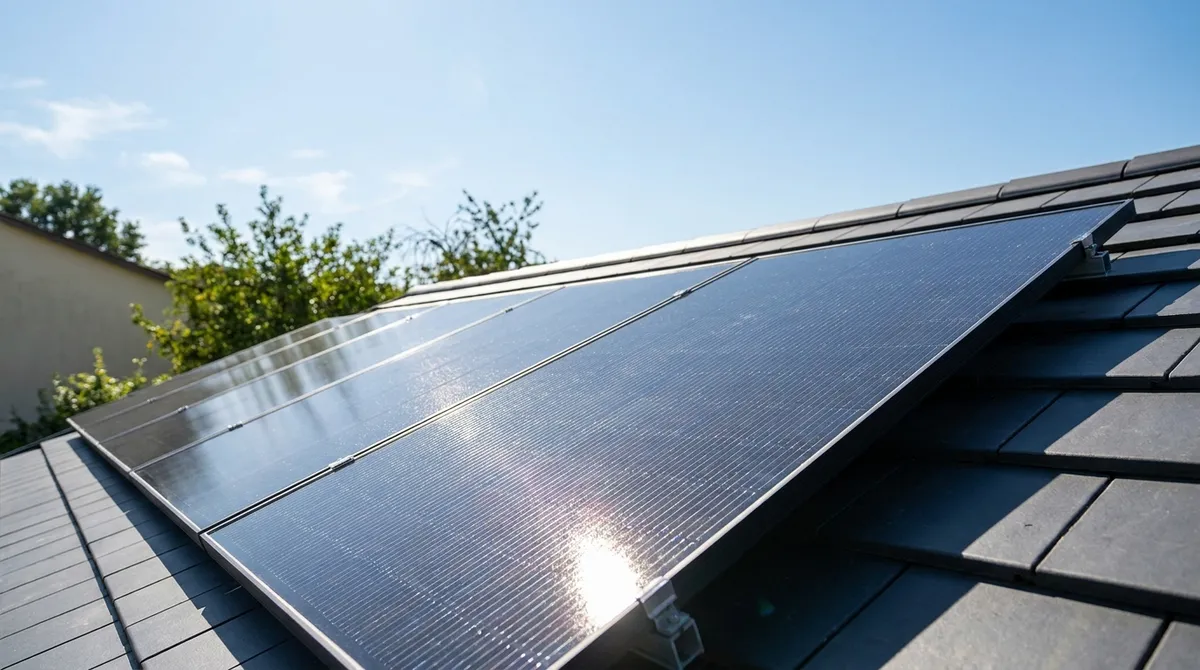
We often talk about solar panels in terms of price, grants or payback — but rarely about what actually happens on your roof. Yet understanding how a panel turns light into electricity helps you make the right choices: where to place the modules, when to run your appliances, how to read your production. Good news, the principle is simple, and it comes down to a few clear steps.
The photovoltaic effect: from light to current
It all begins in the cell, the smallest element of a panel. A photovoltaic cell is made of silicon, the same material as sand and electronic chips. This silicon has a remarkable property: when sunlight strikes it, it releases electrons.
Now, electrons setting in motion is precisely what we call an electric current. That is what the photovoltaic effect is: light sets the electrons in motion, and that motion becomes electricity. No engine, no combustion, no part that wears out — just light meeting silicon.
One essential point, and one often misunderstood: it is the light that produces the current, not the heat. A panel therefore produces under overcast skies too, and a bright but cool day suits it better than a heatwave.
This is the number of cells assembled in a classic residential panel. Linked together and protected by glass and a frame, they form the module you see on the roof.
From the panel to the array of modules
A single cell produces very little. So you assemble several dozen behind tempered glass to form a module (the “panel”), then link several modules together to make up your installation. The larger the surface exposed to light, the larger the production too — hence the importance of the number of panels and their location.
This way of producing explains two precious qualities of photovoltaics. First, nothing moves: there is no engine, no gear, no fluid circulating in a module. That is why a panel lasts decades and demands virtually no maintenance. Second, the production is silent and instant: as soon as a ray of light touches the cell, the current appears, with no warm-up or ramp-up. A solar installation therefore works continuously, quietly, as long as it is daylight.
From the roof to the socket: the electricity’s journey
The current doesn’t go straight from the panel to your washing machine. Between the two, it follows a well-defined path, where each link has a precise role.
1. The panels produce direct current
On the roof, the modules generate electricity as direct current (DC). It is a “one-way” current, the kind from batteries — but it is not the kind your appliances or the electricity grid use, which run on alternating current.
2. The inverter converts the current
This is where the key piece comes in: the inverter. Its role is to turn the panels’ direct current into alternating current (AC), the only kind usable in your house and on the grid. Without it, the electricity produced would remain unusable.
The inverter does far more than convert: it constantly seeks the panels’ optimal operating point to draw the maximum from them, and it transmits the production data to your monitoring app. It is the brain of the installation.
A well-sized and well-fitted inverter determines the performance of the whole installation. It is one of the pieces you should never cut corners on.
See how the installation unfolds →3. The electrical panel distributes the energy
Once converted, the alternating current reaches your electrical panel. From there, it naturally powers the appliances running: the fridge, the internet box, the machine in use, the lighting. The electricity from your roof takes priority over that from the grid.
4. The meter does the accounting
Finally, your meter measures the exchanges with the public grid: what you draw from it when your panels aren’t enough, and what you inject into it when they produce more than you consume. It is what serves as the basis for your bill and for the calculation of any tariffs linked to injection.
Self-consumption and injection: two journeys for your energy
At every moment, the electricity produced takes one of two paths, depending on whether or not you consume it.
- Self-consumption: you use the electricity produced at time T directly, at home. This is the most advantageous case, because this energy doesn’t pass through the grid and replaces electricity you would have paid for.
- Injection: when your panels produce more than your needs of the moment — typically at midday, house empty — the surplus goes into the public grid.
In Wallonia, this injection is governed by the prosumer tariff, which charges a share of the use you make of the grid as a producer. The logic is therefore clear: the more you consume your own production at the moment it occurs, the more worthwhile your installation is. Shifting the dishwasher or the car charging to the middle of the day is self-consumption gained.
Sizing, storage battery, grants: find on the pillar page all the levers to get the best from your production.
Discover the solar page →Monitoring: seeing your production live
How do you know all this is working as expected? Through monitoring. Almost all modern installations are connected to an app that displays, in real time and over time, what you produce, what you consume on the spot and what you inject.
This tracking has two virtues. First it reassures you: at a glance you check that production is at the expected level, and an abnormal drop is spotted quickly. Then it helps you consume better: by seeing the hours of high production, you get into the habit of running your power-hungry appliances at the right time.
What really influences production
Now that the mechanism is clear, you can better understand what makes the amount of electricity produced vary — and what makes no difference to it.
- The available light, and therefore the sunshine: that is the engine. The more light there is, the higher the production.
- The orientation and tilt of the roof: they determine how much light is captured through the day and the seasons.
- Shading: a tree, a chimney or a neighbouring building can reduce production at the affected hours.
- The installed surface: the more modules exposed, the higher the potential.
On the other hand, heat doesn’t help: above a certain threshold, a high temperature even slightly lowers the cells’ efficiency. The Belgian climate, bright and temperate, is in fact well suited to photovoltaics.
Orientation, tilt, shading and module quality: the guide that details the concrete levers of production, with figures to back it up.
Understand solar efficiency →The 30-second recap
- A silicon cell turns light into current: that is the photovoltaic effect.
- The panels produce direct current; the inverter converts it into usable alternating current.
- The current passes through the panel, powers the house, and the meter measures the exchanges with the grid.
- Self-consuming your production is more advantageous than injecting it (prosumer tariff in Wallonia).
- It is the light that produces, not the heat — and monitoring shows you everything live.
Guide verified in May 2026 · updated every year