

“How many panels do I need?” is the first question of any solar project — and the good news is that it can be answered with a simple calculator. No complicated software needed: your electricity bill already contains the essential. This guide takes you from your annual consumption to the number of panels to install, step by step, with concrete examples.
The logic in three steps
Sizing a photovoltaic installation means matching a production to a need. The whole calculation comes down to three moves: start from what you consume, translate it into the power to install, then convert that power into a number of panels. Let’s look at each step.
Step 1 — Start from your annual consumption
The starting point is not the size of your roof nor your budget: it is your real consumption, expressed in kilowatt-hours per year (kWh/year). It appears in black and white on your annual settlement bill. As a benchmark, a Belgian household commonly uses between 2,500 and 5,000 kWh per year, depending on its size and its appliances.
If you are considering a heat pump or an electric car, anticipate: your consumption is going to climb, and your installation must account for it from today rather than being redone in three years.
Step 2 — Translate it into kilowatts-peak
The power of a solar installation is measured in kilowatts-peak (kWp). To know how many you need, we rely on the average unit production in Belgium: a well-oriented kWp produces about 950 kWh per year.
The formula is therefore straightforward:
Power needed (kWp) = annual consumption (kWh) ÷ 950
A home that uses 3,800 kWh per year therefore needs about 4 kWp. This value of 950 kWh/kWp is a prudent national average: a clear south-facing roof often does a little better, an east or west orientation a little less.
Enter your consumption and your roof: the simulator estimates the ideal power, the expected production and the return on investment, with no commitment.
Launch the profitability simulator →Step 3 — Convert the kWp into a number of panels
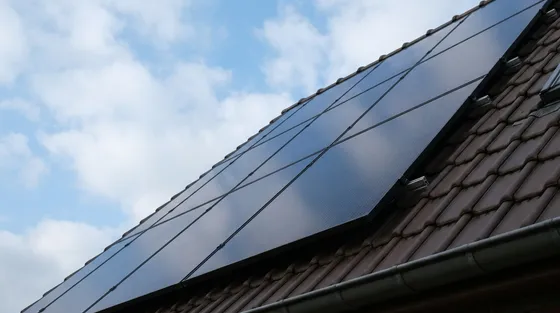
What remains is to go from power to number of panels. The models installed today are typically rated at 400 to 450 Wp per panel. You therefore need about 2 to 2.5 panels to reach 1 kWp.
For our 4 kWp home, that gives 9 to 10 panels. The exact number depends on the precise power of the chosen model: with 450 Wp panels, it drops towards 9; with 400 Wp ones, it rises towards 10.
This is the average annual production of a well-oriented kilowatt-peak in Belgium. It is the pivot figure of the whole sizing exercise: the entire calculation flows from it.
Check your roof
The theoretical calculation gives a target; the roof still has to follow. Count on about 2 m² per panel: an installation of 10 panels therefore takes up roughly 20 m² of well-oriented surface without shading.
In many projects, it is the available surface — and not consumption — that sets the upper limit. A small south-facing roof can perfectly well accommodate fewer panels than consumption suggests; conversely, a large clear roof leaves room to anticipate a heat pump or vehicle charging. That is precisely what the on-site survey checks during installation.
A worked example from start to finish
Let’s take a concrete case to see the method at work. A family uses 3,500 kWh per year and wants to cover its needs as best it can.
- Power needed: 3,500 ÷ 950 ≈ 3.7 kWp, rounded up to 4 kWp to keep a small margin.
- Number of panels: 4 kWp ÷ 0.42 kWp per panel ≈ 9 to 10 panels of 400 to 450 Wp.
- Surface: 10 × 2 m² = 20 m² of well-exposed roof.
With a single calculator, we have gone from a line on a bill to a concrete project. This is exactly the reasoning an advisor follows — they then refine it with the real constraints of your roof.
The factors that adjust the number
The basic calculation gives a reliable range, but four factors come to adjust it upwards or downwards.
- The targeted self-consumption. Wanting to consume as much of your own production as possible, rather than feeding it into the grid, pushes you to size as close as possible to your needs — sometimes by pairing the installation with a battery.
- The orientation and the tilt. A clear south-facing roof at 35° gets the best out of each panel; an east-west orientation produces a little less per panel, which can justify adding one or two.
- Shading. A chimney, a tree or a neighbouring building reduces the production of the panels concerned. You either avoid them or adapt the layout.
- The budget and the roof limit. The final number remains a compromise between the calculated ideal, the available surface and the budget you wish to invest.
This is also why the cost cannot be deduced linearly from the number of panels: find the up-to-date ranges in our solar panel price guide.
Why the quote always refines the calculation
The method in this article gives you an accurate order of magnitude — enough to discuss calmly, check a quote and avoid unpleasant surprises. But the final figure comes from the on-site survey: exact orientation, slope, shape of the roof, shading, real power of the available models and self-consumption objective then come into play.
In the vast majority of cases, the on-site survey confirms the calculated range and adjusts it at the margin, rarely more. You therefore arrive at the meeting on familiar ground, able to understand and challenge each line of the proposal.
The recap in 30 seconds
- Start from your annual consumption in kWh, readable on your bill.
- Divide it by 950 kWh/kWp to get the power to install.
- Count 2 to 2.5 panels per kWp (models of 400 to 450 Wp).
- Check the roof: about 2 m² per panel, without shading.
- Example: 3,500 kWh → ~4 kWp → 9 to 10 panels over ~20 m².
Guide verified in May 2026 · updated every year