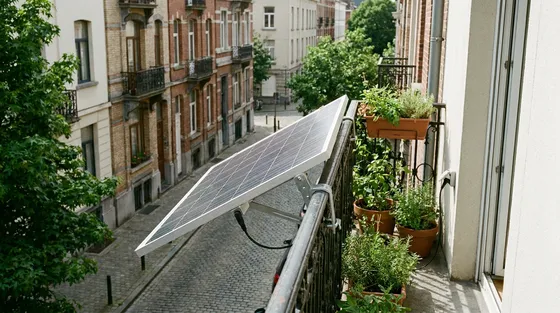



“Plug & play” solar kits are multiplying: a few panels, a micro-inverter, a socket, and you would be generating your own electricity in ten minutes. The promise is enticing — but one question keeps coming back: is it really legal in Belgium? The short answer is: yes, provided you respect a precise framework. This guide goes through the 2026 rules, without jargon and without shortcuts, so you know exactly what to declare and check before plugging in.
This guide describes the regulatory framework known in May 2026. Procedures evolve and differ from one operator to another: treat these lines as a starting point, and always confirm with your DSO.
”Plug & play” does not mean “no formalities”
The term plug & play describes one thing: the ease of installation. No worksite, no roof to drill, a connection to a socket. It in no way describes a particular legal status. In Belgium, as soon as an installation generates electricity connected to the grid, it falls within the scope of several rules: declaration to the network operator, electrical compliance and, potentially, taxation of the generation.
In other words: ease of installation creates no exemption. A kit plugged into a socket is, in the grid’s eyes, a generation installation like any other — simply smaller. To understand the concept and the components of such a kit, first see our plug & play solar panel guide; here, we focus on the legal framework.
The declaration to the network operator (DSO)
This is the most often forgotten step — and the most important. In Belgium, electricity distribution is run by distribution network operators (DSOs) depending on your municipality: ORES and Resa on the Walloon side, Fluvius in Flanders, Sibelga in Brussels. Any generation installation connected to their grid must be declared to them.
This declaration lets the DSO know the power injected into the grid, adapt the metering and, where applicable, apply the corresponding tariff. It is not a decorative formality: it is what makes your installation compliant.
Even a small plug & play kit connected to the grid must be declared to your operator (ORES, Resa, Fluvius, Sibelga). Undeclared generation is in breach, regardless of its power. The exact procedure depends on your DSO and your region: check it before any connection.
See our solar solutions →What power without heavy formalities?
The widespread idea of a “free threshold” below which you could plug in without saying anything often comes from abroad. In Belgium, caution is the rule: there is, to date, no clear threshold exempting a grid-connected kit from any declaration. The formalities are, however, proportionate to the size of the installation — a small domestic generation falls under a simplified procedure, not the path of a large power plant. The right reflex is still to ask your DSO for the procedure that applies to your precise power.
Electrical compliance: RGIE and decoupling
Beyond the declaration, the installation must be safe. Two requirements concentrate most of the risks.
The RGIE
The General Regulation on Electrical Installations governs every domestic electrical installation in Belgium. Plugging in a generation source changes the behaviour of your circuit: depending on the configuration, a check or a compliance upgrade may be required. A kit slapped onto an unsuitable socket is not neutral from a safety standpoint.
Decoupling protection
This is the decisive technical point. An inverter connected to the Belgian grid must include compliant decoupling protection (C10/11 reference): in the event of a grid outage, it instantly interrupts generation. Without it, your kit could keep injecting current into a line that is supposed to be de-energised — a real danger for the technicians working on it.
This is the connection reference that an inverter’s decoupling protection must meet on the Belgian grid. Many freely sold imported kits do not carry this approval: check it without fail before buying.
Many very cheap kits sold online do not meet this requirement. An unbeatable price sometimes hides a micro-inverter not approved for Belgium: an apparent saving, a very real risk.
The impact on the meter and the prosumer tariff
Generating electricity changes your relationship with the grid, so potentially your bill. In Wallonia, the prosumer tariff applies to connected generation installations: it aims to cover the use of the grid by those who inject into it. As soon as a connected kit comes into service, you may fall under this framework, depending on the rules in force and your type of meter.
That is a further reason to declare: regularising your tariff situation from the outset avoids any dispute after the fact. To understand how this tariff works and what it represents, see our dedicated prosumer tariff page.
Wallonia, Flanders, Brussels: three distinct frameworks
Belgium does not have a single solar framework, but regional rules layered on top of the national RGIE. The broad lines differ:
- Wallonia — main DSOs ORES and Resa; prosumer tariff in force for connected installations. The declaration to the DSO conditions compliance.
- Flanders — grid run by Fluvius, with its own declaration and metering arrangements. The injection and tariff rules have their own logic there.
- Brussels — grid operated by Sibelga, with a framework and support mechanisms specific to the Region.
The common denominator, everywhere, stays the same: declaration to the DSO and compliant equipment. The arrangements change; the principle does not. Before buying, first identify your DSO based on your municipality — it holds the exact procedure that concerns you.
The risks of an undeclared installation
Ignoring these formalities exposes you to several troubles, from the most administrative to the most serious:
- Forced regularisation — a DSO can require a compliance upgrade, even the disconnection of an undeclared device.
- Insurance — in the event of a claim of electrical origin, a non-compliant or undeclared kit can complicate, even compromise, the cover.
- Taxation — undeclared generation can give rise to a retroactive tariff regularisation.
- Safety — the absence of approved decoupling protection creates a real risk for anyone working on the grid.
None of this is inevitable: the vast majority of these risks disappear with a proper declaration and compliant equipment. The legality of a plug & play kit does not hinge on its size, but on these two conditions being met together.
Plug & play or a supported installation?
A compliant, declared plug & play kit remains a modest top-up. For generation that covers a real share of your consumption, a properly sized and correctly connected solar panel installation is on a different scale — and compliance, like the declaration, is then handled end to end. If you are hesitating between the top-up and the full project, our opinion on plug & play honestly compares the two approaches.
The 30-second recap
- Legal, yes — but “plug & play” exempts you from no formalities.
- Declaration to the DSO (ORES, Resa, Fluvius, Sibelga): the rule, even for a small kit.
- Compliance RGIE + C10/11 decoupling protection on the micro-inverter.
- Prosumer tariff possible as soon as you generate connected to the grid.
- Distinct regional rules — always confirm with your DSO.
Framework checked in May 2026 · to be confirmed with your network operator