

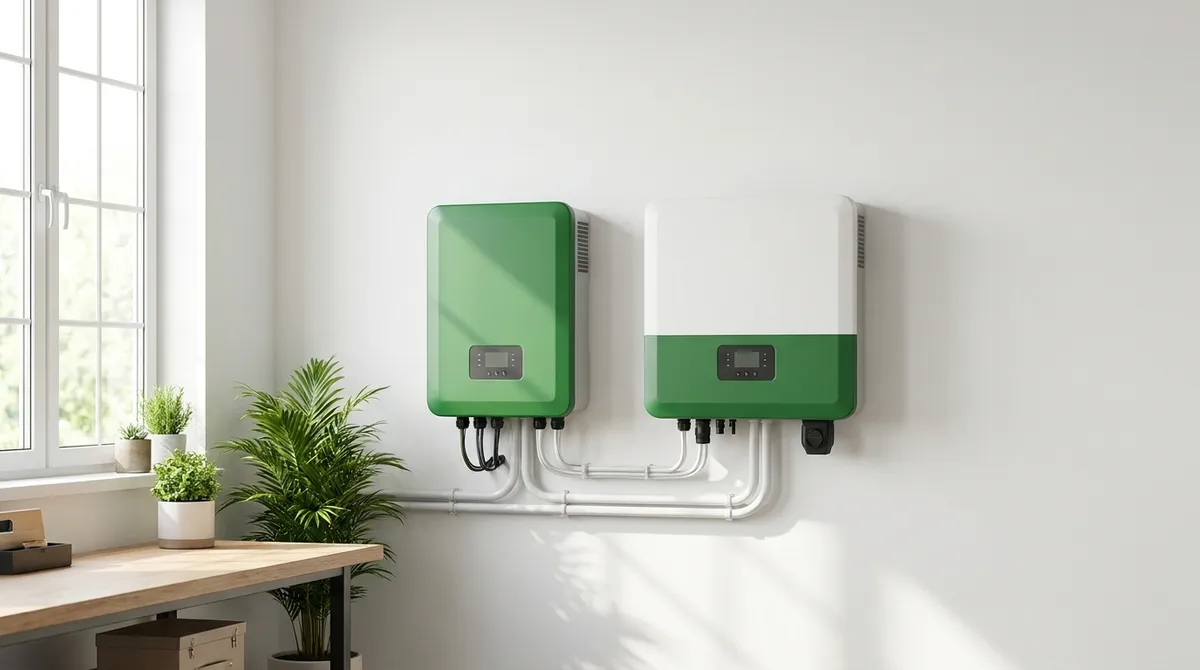
You choose your solar panels with care, then often forget the device that decides a good part of their output: the inverter. The panels make direct current; your home and the grid run on alternating current. It is the inverter that does the translation — and depending on the type you install, your roof will yield more or less, especially if it is shaded or complex. Here is how to make the call.
What the inverter does, exactly
As long as your panels are producing, the inverter continuously converts their current to power your appliances and feed the surplus back. But it does far more than convert: it constantly seeks the panels’ optimal operating point, monitors output and cuts the installation in the event of a grid fault. It is therefore at once the translator, the conductor and the dashboard of your installation.
Its quality is measured mainly by three things: its efficiency (the energy it does not lose during conversion), its ability to manage imbalances between panels, and its longevity. The right choice depends above all on the shape and exposure of your roof.
The main families of inverters
Three architectures cover almost all residential installations. They all convert the same current, but handle an imperfect roof and the future addition of a battery very differently.
A single device for the whole chain of panels. Simple, reliable and economical on a clear roof.
Micro-inverters Anti-shadingA box under each panel, making it independent. Ideal in cases of shading or multiple orientations.
Hybrid inverter Battery-readyManages panels and battery on the same device. The smart choice if a battery is in your plans.
The central inverter (string)
This is the historic architecture: a single inverter, mounted on the wall near the meter, manages all the panels wired in series. Its logic is unbeatable in its simplicity and its cost stays the lowest. The flip side: all the panels in a chain work together, so the weakest panel drags the whole row down. A chimney that shades a single module, and the output of the entire chain drops off. On a single, well-oriented and shade-free roof, however, it is the most rational choice.
Micro-inverters
Here, the logic is reversed: a small inverter is fitted directly under each panel, which becomes fully independent. A shaded or poorly oriented module no longer penalises its neighbours — each gives its best. It is the go-to answer for complex roofs: tree or chimney shading, several pitches, different orientations. An added bonus: monitoring is done panel by panel, and the voltage stays lower on the roof. In return, there is one box per panel, which raises the price and the number of installed parts.
The hybrid inverter
The hybrid is a central inverter that can additionally manage a battery on the same device. It decides in real time whether to send electricity to the home, the battery or the grid. If a home battery is in your plans — even a few years out — going straight for a hybrid avoids adding a second device later. It is now the default choice for anyone wanting to maximise self-consumption.
Power optimisers
Between the two worlds, optimisers offer a compromise: you keep a central inverter, but add a small module under each panel to make it independent. You thus recover a good part of the micro-inverters’ anti-shading advantage, with a single inverter to replace when the time comes. An interesting option on a partly shaded roof.
This is the efficiency of a modern inverter: it loses only 2 to 3% of the energy during conversion. The gap between good brands is small — the fit to your roof weighs more than the last tenth of a percent.
The criteria that make the difference
With efficiency close everywhere, it is other criteria that should guide your choice.
- Shading and orientation. Clear roof on a single pitch: central inverter. Shade, chimney, several orientations: micro-inverters or optimisers.
- Scalability. A battery in view? The hybrid saves you a future replacement.
- Monitoring. Is overall tracking enough, or do you need to see output panel by panel to spot an anomaly? Micro-inverters offer the finest tracking.
- Longevity and warranty. The inverter is the part replaced earliest: the warranty length is a decisive criterion (see below).
- Price. For equal output, the central remains the cheapest; micro-inverters and hybrids cost more, justified by the gain in output or the battery management.
Central, micro-inverters or hybrid: the 2026 price benchmarks by the output of your installation, and what makes the bill vary.
See inverter prices →The sensitive point: lifespan
This is the criterion most often forgotten. Your panels are guaranteed and last 25 years and more; the central inverter, for its part, has a lifespan of around 8 to 12 years. In other words, you will probably replace it once during the life of the installation — a line to anticipate from the start in your profitability calculation.
Micro-inverters, each less heavily loaded than a single central inverter, often benefit from longer warranties. In all cases, the warranty length stated on the quote is a reliable indicator of the manufacturer’s confidence: it is a point to compare line by line.
Panels, inverter, battery: what lasts for decades, what gets replaced along the way, and how to read the warranties.
See the lifespan of panels →How to decide based on your roof
Rather than looking for “the best” inverter in the abstract, start from your roof. In most cases, an obvious choice emerges quickly.
- Simple roof, single pitch, no shade, no battery planned? The central inverter is the most economical and durable choice.
- Shading, chimney, several orientations? Micro-inverters (or optimisers) recover the output the central would leave on the table.
- A battery in your plans? The hybrid inverter saves you a second device and maximises self-consumption.
- Broken-up roof and battery in view? A hybrid paired with optimisers combines both advantages.
None of this is decided alone from a catalogue: the precise sizing depends on your roof, your consumption and your plans. That is exactly what a technical visit pins down.
From the on-site survey to the grid connection: the steps of a panel installation and the moment when the inverter choice is truly decided.
See how an installation unfolds →The 30-second recap
- Central inverter — simple and economical, perfect on a clear single-pitch roof.
- Micro-inverters — one per panel: the answer to shading and multiple orientations.
- Hybrid inverter — manages the battery on the same device: the choice that anticipates.
- The efficiency (97–98 %) varies little: the fit to your roof counts more.
- The inverter lasts 8 to 12 years versus 25 years for the panels — to plan in the budget.
Guide reviewed in May 2026 · updated every year