

Insulation materials: which insulant for which job?
Mineral wool, polyurethane, polystyrene, cellulose, wood fibre: each material has its own lambda (insulating power), its price, its eco-credentials and its ideal use. This guide compares the families to help you choose — or to understand what we’re recommending.
- λ 0.022
- PUR (the most insulating)
- λ 0.035
- wool (the standard)
- λ 0.038
- cellulose (eco-friendly)
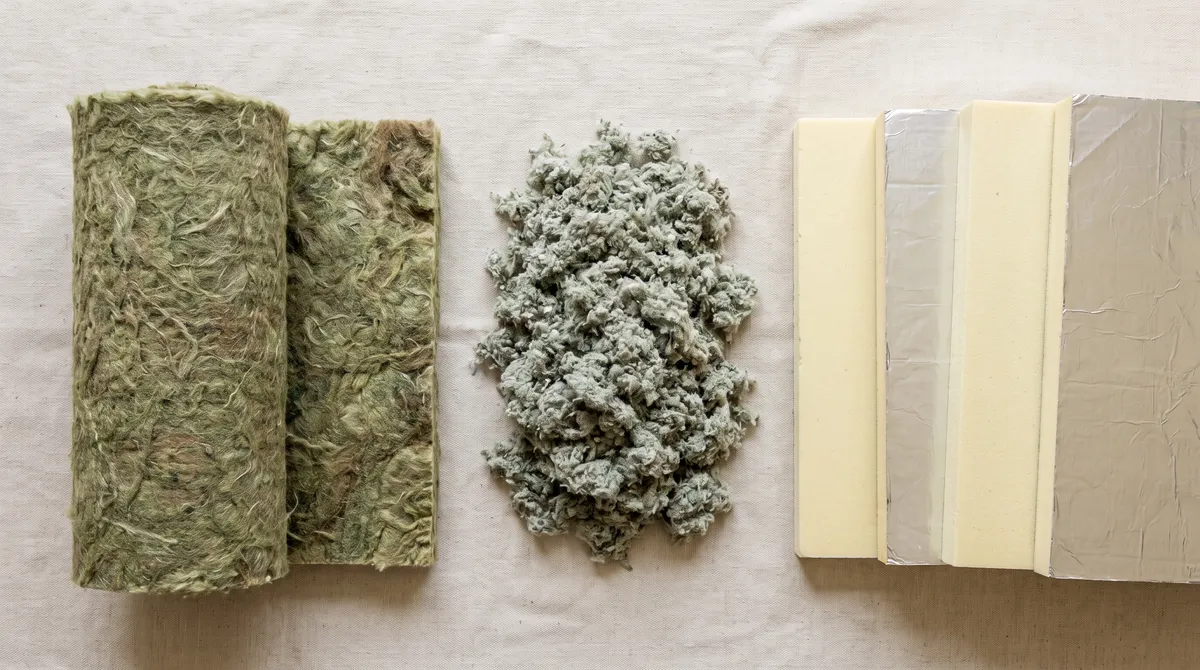
Understanding each family of material
Lambda (λ) measures thermal conductivity: the lower it is, the better the material insulates at equal thickness.
- Glass wool λ 0.032–0.035
The most-fitted material in Belgium. Affordable, a good thermal and acoustic insulant, non-combustible (A1). Rolls, panels or blowing.
- Rock wool λ 0.034–0.038
Non-flammable (A1), an excellent acoustic and thermal insulant. Slightly pricier than glass wool. Ideal for exterior wall insulation and fire safety.
- PUR / PIR λ 0.022–0.028
The best lambda on the market: less thickness is needed for the same performance. Rigid panels or sprayed foam. Ideal where space is tight (between rafters, cellar).
- EPS / XPS λ 0.030–0.038
Expanded (EPS) or extruded (XPS) polystyrene. Light, moisture-resistant (XPS). Common in exterior wall insulation (graphite EPS), floors and base courses.
- Cellulose λ 0.038–0.042
Recycled newsprint, blown into lofts or injected into walls. Eco-friendly, excellent thermal lag (summer comfort). Treated against fire.
- Wood fibre λ 0.038–0.043
Bio-based, the best thermal lag (summer comfort under the roof). Pricier. Rigid or flexible panels, blowing.
* Indicative lambda values for common products. The exact lambda is shown on the product’s technical sheet.
Synthetic, mineral or bio-based?
Three broad families, three philosophies. The choice depends on the use, the budget and your values.
Synthetics (PUR, EPS)
- Best lambdaPUR at 0.022: the thinnest insulant at equal performance.
- Moisture resistanceXPS and closed-cell PUR resist water. Ideal in cellars and base courses.
- Reduced thicknessWhen space is tight (between rafters, low cellar), PUR is unbeatable.
- RigidityRigid panels can be fixed, bonded and rendered (exterior wall insulation).
Bio-based (cellulose, wood)
- Lower carbon footprintCellulose and wood fibre store CO₂ and take little energy to produce.
- Better summer comfortThe high thermal lag of wood fibre and cellulose delays the summer heat.
- Good acousticsFibrous materials (cellulose, wool, wood) absorb noise better.
- Fast blowing (cellulose)In unused lofts, blowing cellulose is the quickest and most economical move.
Which insulant for which location?
Each area of the house has its material of choice.
-
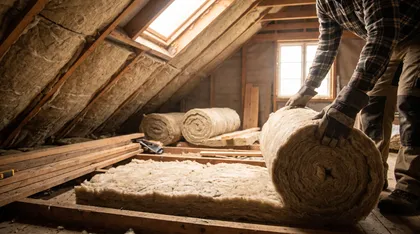
Roof / converted loft
Glass or rock wool in panels/rolls between the rafters. PUR in sarking or where space is tight. Wood fibre for summer comfort.
-
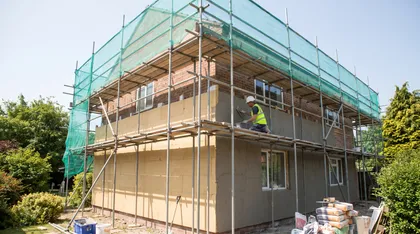
Facade (exterior wall insulation)
Graphite EPS (the most common) or rock wool (fire safety). Rigid panels + render or cladding.
-
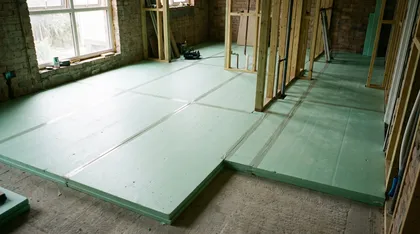
Floor / cellar
PUR sprayed onto the cellar ceiling (the most common). XPS in rigid panels within a screed. Moisture resistance is essential.
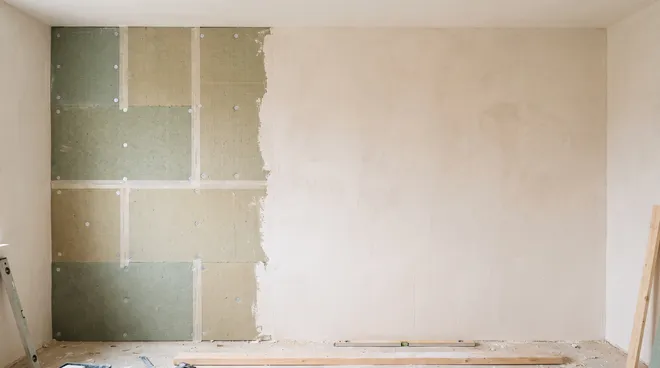
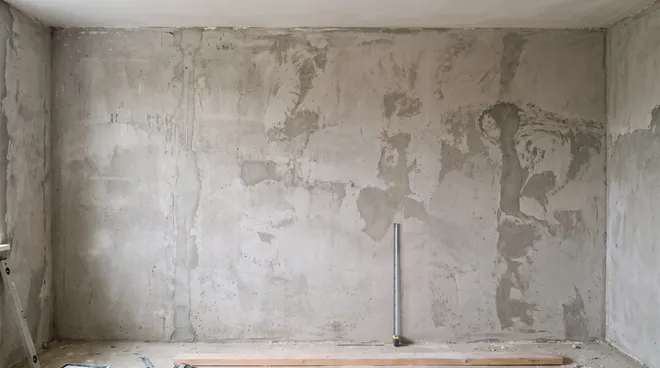
PUR on the roof, cellulose in the loft, injection in the walls: each zone its own material
A full renovation where the client wanted to understand the materials. The result: PUR between the rafters (tight space), blown cellulose over the unused attic loft, injected PUR foam in the cavity walls. Each material chosen for its zone.
- 3 materialsfor 3 zones
- U < 0.24everywhere
- Grantson every item
Wool, PUR or bio-based?
The table to compare the main families of insulants.
| Critère | Mineral woolVous êtes ici | PUR / PIRVoir la gamme → | Cellulose / woodVoir la gamme → |
|---|---|---|---|
| Lambda | 0.032–0.038 | 0.022–0.028 | 0.038–0.043 |
| Price | The gentlest | Intermediate | Variable |
| Fire | Non-combustible (A1) | Combustible (treated) | Treated against fire |
| Summer comfort | Medium | Low | Excellent |
| Eco-credentials | Good (70% recycled) | Fossil origin | Excellent |
| Moisture | Sensitive | Resistant (closed cells) | Sensitive |
| Best for | Roof, exterior wall insulation, partitions | Cellar, tight space | Lofts, eco-credentials |
- roof
Roof insulation
The first zone to insulate. The material depends on the method (between rafters, sarking, blowing).
See the roof → - walls
Wall insulation
Injection (foam), internal lining (panels) or exterior wall insulation (EPS/wool) depending on the wall structure.
See the walls → - floor
Floor insulation
PUR sprayed in the cellar or XPS in a screed. Moisture resistance is essential.
See the floor → - loft
Loft insulation
Blown cellulose or wool — the fastest, cheapest move.
See the loft → - facade
Exterior wall insulation
Graphite EPS or rock wool in exterior wall insulation — maximum performance for the walls.
See exterior wall insulation → - ↑ category
All insulation
An overview of our insulation solutions in Belgium.
Back to the guide →
How much do the different materials cost?
The price varies by material and fitting method. Here are some benchmarks per m².
See detailed insulation pricing →* Indicative material-only price. The fitted cost depends on the method and location.
- Glass wool (roll) €5–12/m²for R = 5 (18–20 cm)
- PUR rigid panel €15–30/m²for R = 5 (11–14 cm)
- Blown cellulose €8–15/m²for R = 6 (25–30 cm)
- Wood fibre €15–35/m²for R = 5 (18–22 cm)
Your questions about insulation materials
What is the best insulation material? +
There is no universal “best”. PUR has the best lambda (insulates with the least thickness), rock wool is non-flammable, cellulose is the most eco-friendly, wood fibre offers the best summer comfort. We choose based on the location, the budget and your priorities.
What is lambda (λ)? +
Lambda measures the material’s thermal conductivity, in W/(m·K). The lower it is, the better the material insulates. At equal performance (same R), a low-lambda material is thinner.
Is glass wool dangerous? +
Modern glass wool poses no health risk once fitted. During handling, wearing gloves and a mask is recommended. Once in place and covered, it emits nothing.
Is PUR eco-friendly? +
PUR is of fossil origin and its manufacturing carbon footprint is high. But its lifespan (50+ years) and performance (less material for the same R) partly offset this. If eco-credentials are a priority, cellulose or wood fibre are preferable.
Can you mix materials within the same house? +
Yes, and it’s actually common. Each area of the house has its constraints: PUR in the cellar (moisture), wool in the roof (fire), cellulose in the loft (speed/eco-credentials). We optimise zone by zone.
Do grants depend on the material? +
No, grants depend on the performance achieved (U or R value), not on the material. You are free to choose the material as long as the performance threshold is met.
Get your free insulation quote within 48h
Free technical visit, material advice by zone, grants calculated. Describe your project in under a minute.
- Free and no obligation
- Material advice tailored to each zone
- Fitted by our certified teams